The KD Rhine cruise castles sequence does most of the work of a Mittelrhein day for you. From the covered deck of a southbound boat between St. Goar and Bingen, the gorge delivers seven major castles in two hours: a cat-and-mouse rival pair, the Loreley cliff, a Gilded Age New York family’s restoration of their Huguenot ancestors’ lost town, a 1326 toll castle on an island, and three more before you tie up at dusk.
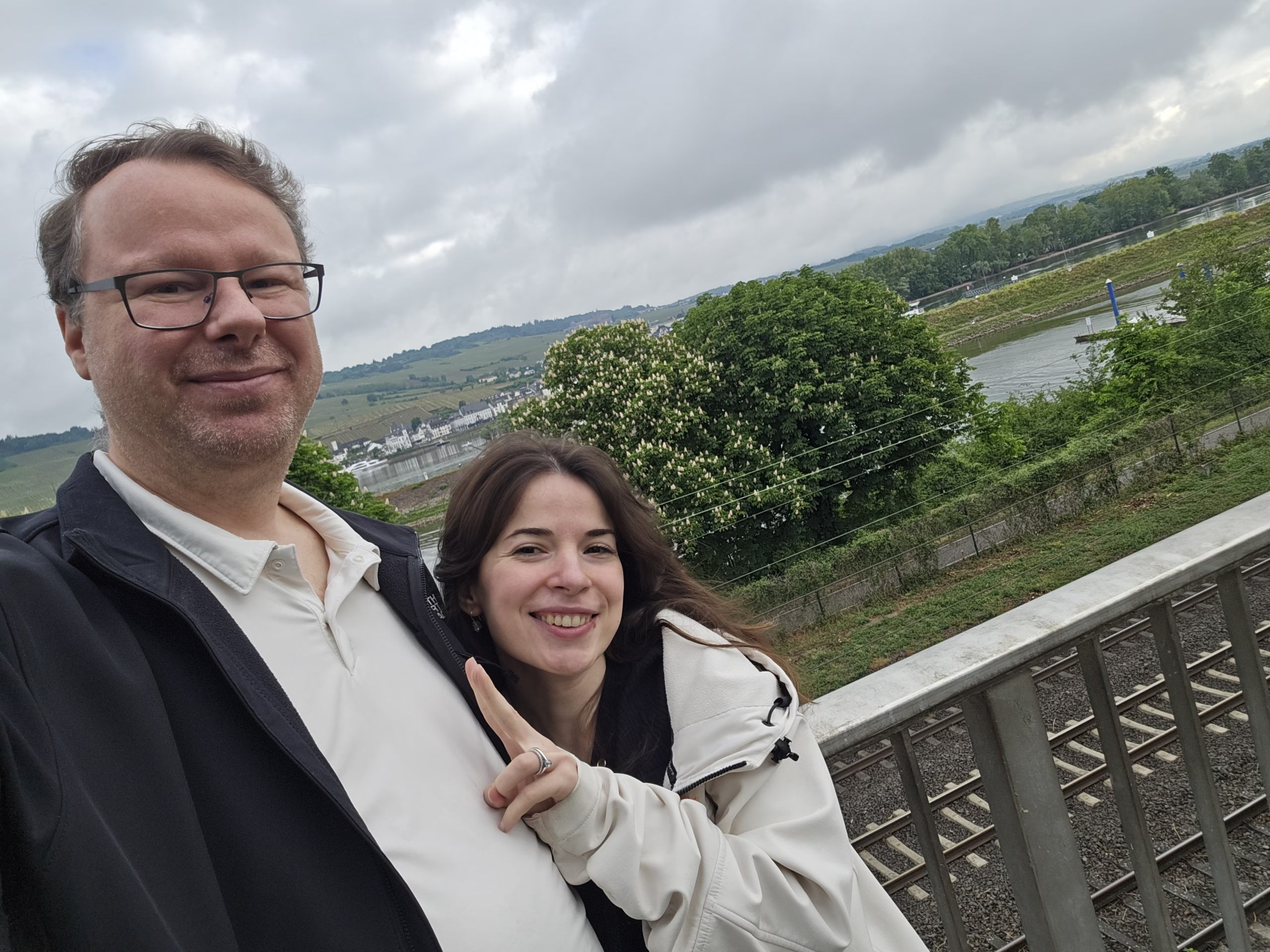
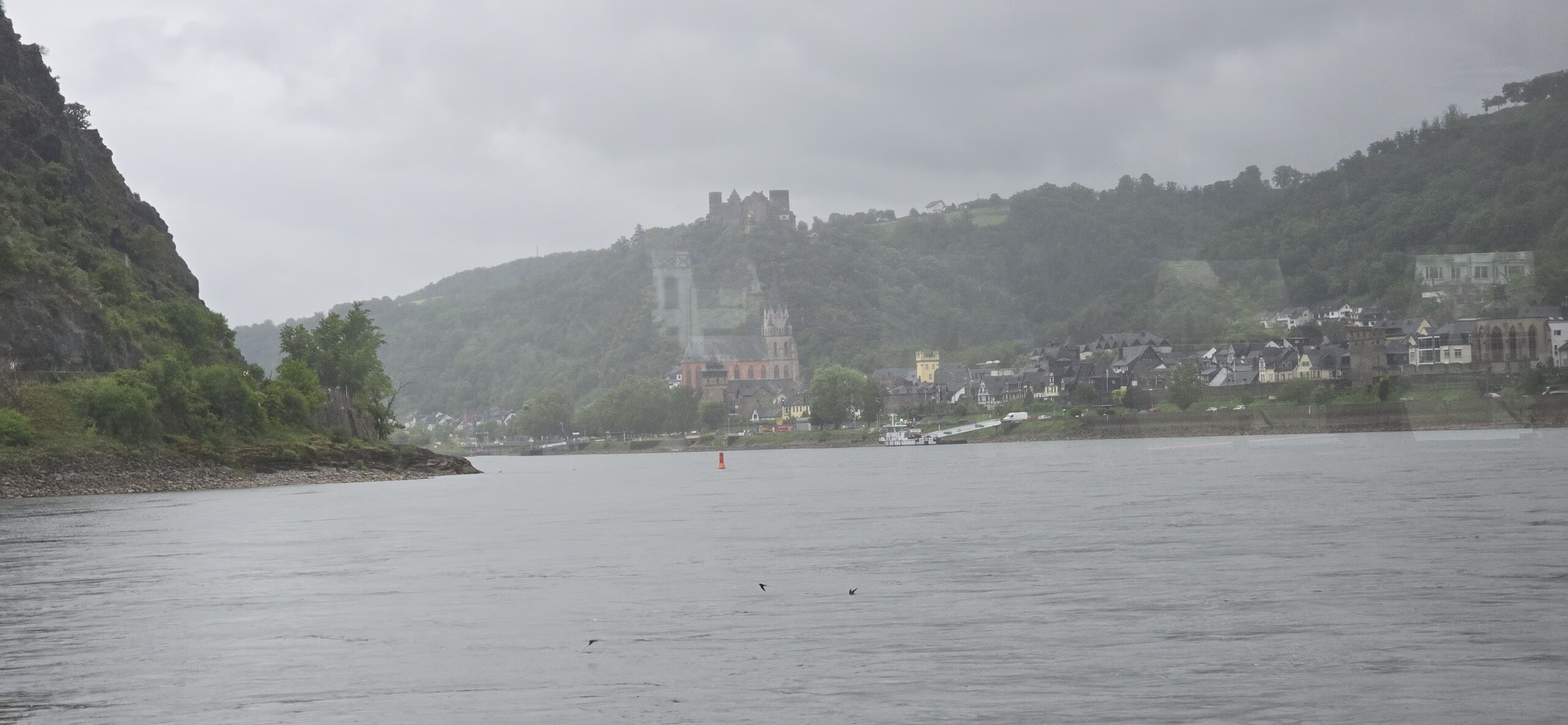
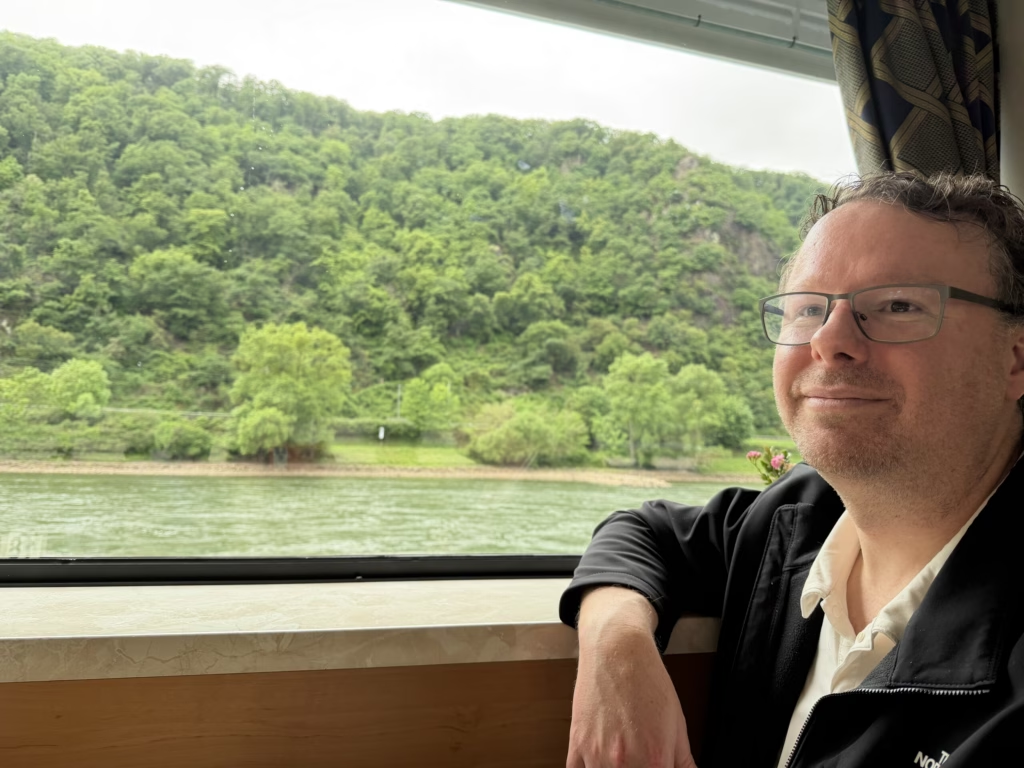
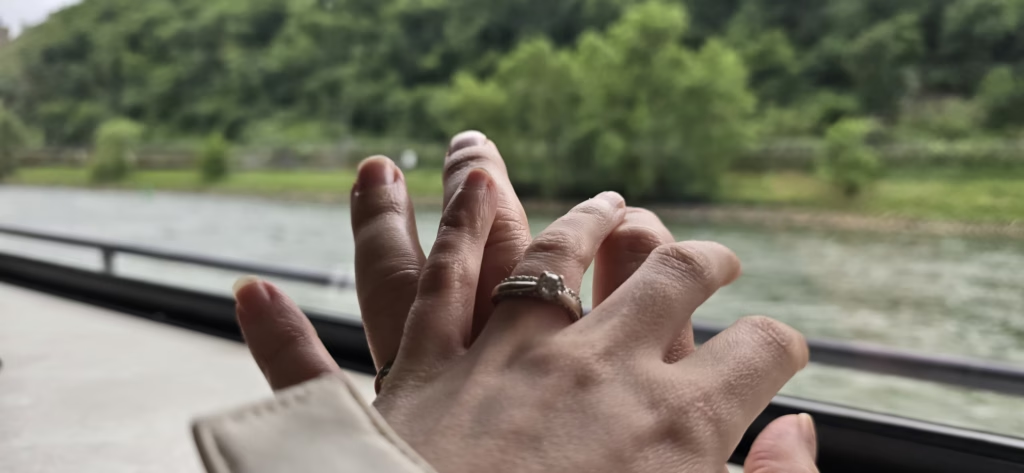
We did this on our second wedding anniversary, in steady rain, on the 16:10 last southbound, as the consolation cruise after a rained-out Burg Rheinfels visit. Rain is closer to what the Romantic painters who came down the Rhine after 1815 — Turner on his repeated Rhine tours from 1817 onward, Schinkel sketching for his Stolzenfels reconstruction work, the Düsseldorf school in the 1830s and 1840s — actually came for. The bright postcard light KD now markets is a 20th-century tourism aesthetic; the gorge under mist, low cloud, and slate-roof rain is the one Turner watercolored. Post 4 of 5 in the Rhine anniversary series.
Visit at a glance
- Official site: k-d.com/en (KD Rheinschiffahrt, EN portal)
- Address: KD Anlegestelle St. Goar, Heerstrasse 86, 56329 Sankt Goar
- Opening hours: Daily late March–early November; last southbound boat ~16:00
- Parking: Park at Bingen (Parkplatz Fruchtmarkt, €6/day); ride RB26 up before cruise
- Cost: Adult one-way St. Goar→Bingen €28 (20% rail-customer discount at on-site booth)
- Accessibility: Covered saloon, open upper deck, accessible toilets; wheelchair boarding needs crew assistance
- Distance from Kaiserslautern: ~120 km via A6 → A61 → B9; or ~95 km to Bingen + RB26
- Time on site: ~2 h southbound + 30 min boarding
- Previous stop: St. Goar in Rain
A bit of history
KD is older than most passengers realize. The Preussisch-Rheinische Dampfschiffahrts-Gesellschaft was founded in Cologne in 1826; the Koln-Dusseldorfer Deutsche Rheinschiffahrt is the direct continuation. Its signature vessel is the RMS Goethe, a 1913 side-wheel paddle steamer that ran under steam until 2008 (diesel-hydraulic since, original paddle wheels retained); the operator calls her “the largest side-wheel ship in the world to this day”.[3] As of May 2026: she runs the KD Nostalgia Route between Koblenz and Rudesheim daily except Mondays from late April through early October, and was at the St. Goar quay around noon on the day we sailed [primary-source: visited 2026-05-06]. The 16:10 southbound we boarded was a modern covered-saloon vessel, with the Goethe still dockside.
The Upper Middle Rhine Valley was inscribed on the UNESCO list in 2002 as Site 1066, a 65-kilometer corridor with roughly 40 castles along the banks.[4] Most were built between the 12th and 14th centuries to enforce Rheinzoll (Rhine tolls): princes and bishops paid for their courts by stationing garrisons at chokepoints and taxing the barges. Most came down in two waves: the Pfalzischer Erbfolgekrieg (Nine Years’ War of the Palatine Succession) from 1689, when French marshals slighted the German Rhine; and the French Revolutionary demolitions of 1796 to 1813. The 19th-century Rheinromantik rebuilt some as private villas, and you sail through both layers from the deck.
What to do here
Board at St. Goar Anlegestelle, five minutes north of the train station. As of May 2026: the booth opens roughly an hour before each departure; buy in person to claim the rail discount [primary-source: visited 2026-05-06].
Sit starboard. Katz, Maus, Pfalzgrafenstein’s island, and Reichenstein are right-bank passages; Schonburg, Gutenfels, and Stahleck land high enough on the left bank to read from either side. Covered saloon for rain photography; upper deck for the gorge soundscape.
Bring something onboard. We carried a 0.2-liter Brombeerlikor from Stefans Wein- und Weihnachts-Paradies in St. Goar Altstadt onto the cruise wrapped in white paper [primary-source: visited 2026-05-06]; we ended up keeping it sealed as a memento of the day rather than opening it on deck. The saloon sells coffee, beer, and snacks if you want pacing on the cruise itself, and a take-aboard pour from one of the small Altstadt cellars is the cruise’s right register if you prefer that.
Spot in cruise order. Save this post on your phone and call them aloud as they come. Pfalzgrafenstein is the visual peak; Schonburg at Oberwesel is the editorial one.
The seven castles southbound from St. Goar
The cruise runs ~32 kilometers downstream through the deepest part of the UNESCO corridor.
Burg Katz and Burg Maus
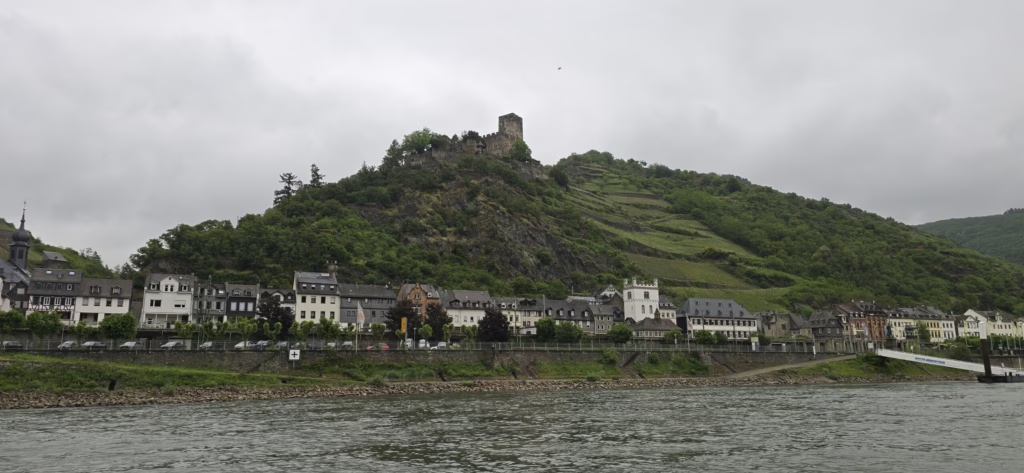
You board with Burg Katz already visible above St. Goarshausen on the right bank, and it slides past on your port side as the boat pulls out. Six kilometers down, above Wellmich, Burg Maus appears. Maus was built first, from 1356, by the Archbishop of Trier to challenge the toll regime of the Counts of Katzenelnbogen.[5] Burg Katz (formally Burg Neukatzenelnbogen) was the Katzenelnbogen response, built around 1360 to 1371 directly upstream.[6] The cat-and-mouse nicknames are not medieval; the earliest documented use of Maus as a folk name is 1744. Katz is privately owned (Japanese investor since 1989) and closed to the public; Maus runs a small falconry with limited hours.
Loreley
Two kilometers below St. Goarshausen, the right bank rises to the Loreley, a 132-meter slate cliff at the river’s sharpest bend, narrowing the Rhine to ~113 meters at its tightest. Not a castle: the geographic protagonist of the gorge. The legend of the golden-haired siren combing her hair on the rock is Heinrich Heine’s 1824 poem Die Lorelei, not a medieval source. The Freilichtbuhne Loreley amphitheater on the plateau above hosts large summer concerts. From the deck you see the bend, the cliff face, and the small white Loreley statue on a basalt outcrop at water level.
Oberwesel and Schonburg: the Rhinelander reverse-Atlantic story
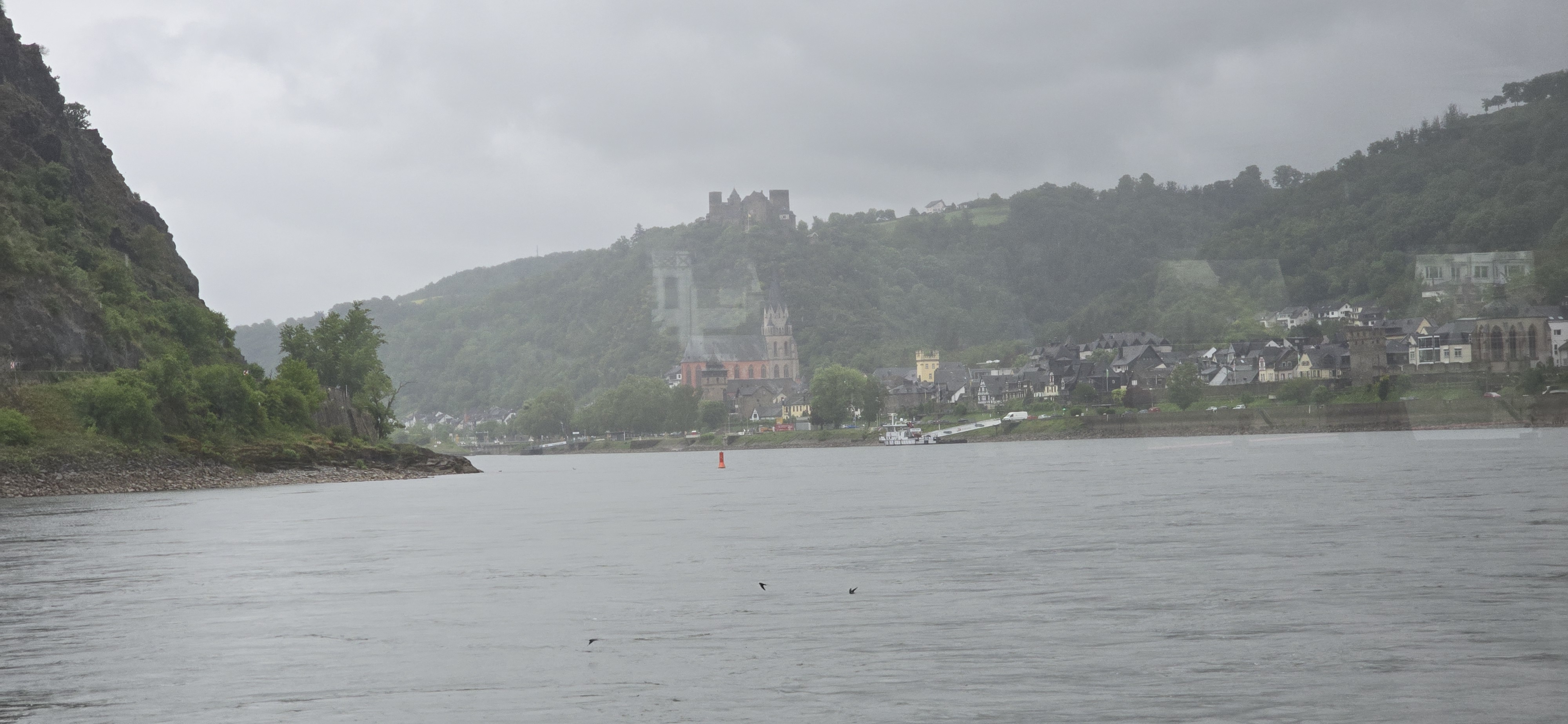
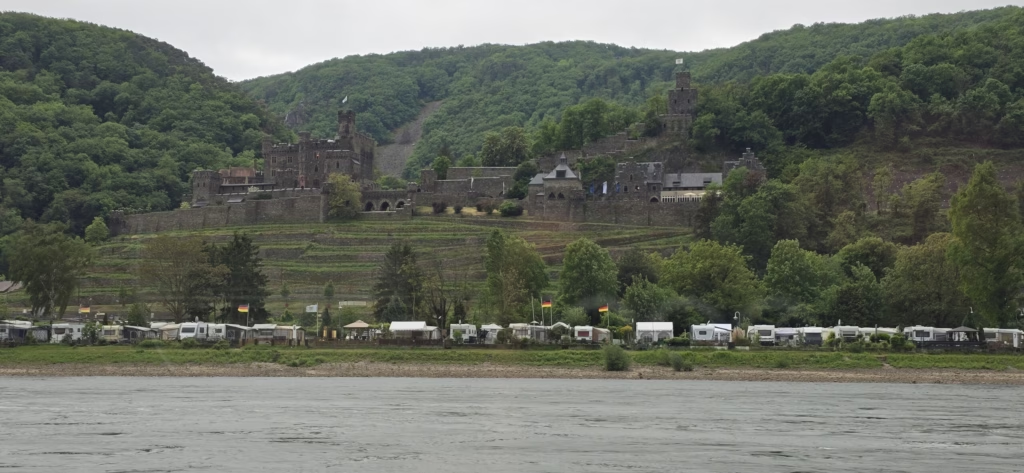
About 12 kilometers below St. Goar, on the left bank, the boat passes Oberwesel, with one of the most complete medieval ring walls on the German Rhine (16 of 21 original towers survive). Above it, on a wooded ridge, sits Burg Schonburg, a sprawling complex of residential houses inside one Ringmauer. This is the post’s editorial centerpiece.
Schonburg was built from the 12th century by ministerial families, destroyed in the 1689 French sweep, and stood as a ruin for nearly two hundred years.
Then in 1884 the town of Oberwesel sold the ruin to a New York real estate dynasty: brothers T.J. Oakley and Philip Rhinelander, descendants of Philip Jacob Rhinelander, who emigrated from the Rhineland to New York in 1686 as a Huguenot fleeing the revocation of the Edict of Nantes.[7] The Wikipedia DE Burg Schonburg article locates the ancestral village “gegenuber der Stadt Oberwesel auf der Hohe” (across the Rhine, on the heights)[12]: the family bought back the castle their ancestors had grown up looking at from the opposite bank. T.J. Oakley led the restoration from 1885 through 1920.
After WWII the castle passed to the Huttl family, who from 1957 have run parts of it as the Hotel Auf Schonburg. A rare Mittelrhein restoration not done by Hohenzollerns, and one that does not appear in any English-language Rhine cruise guide we have read.
Burg Gutenfels above Kaub
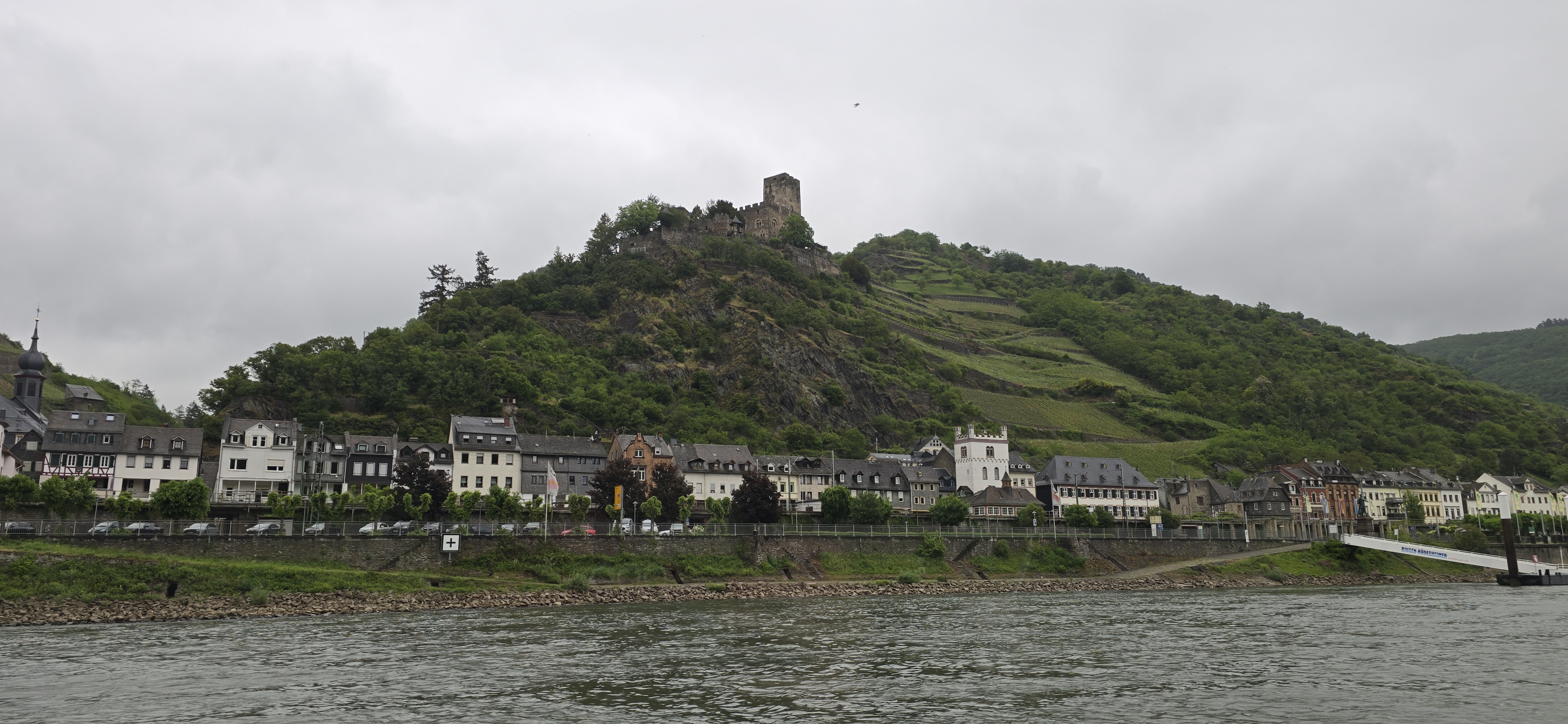
Just upstream of the Pfalzgrafenstein island, on the left bank, Burg Gutenfels sits above the wine town of Kaub. The popular story that the mayor of Kaub bribed the Napoleonic demolition team is not in any primary source we have found.[8] What actually happened: the Nassau government staged the destruction in three phases, auctioning inventory 1805, woodwork 1807, masonry 1813.[14] Friedrich Habel bought the ruins in 1833; Gustav Walter acquired the castle in 1888 and rebuilt it between 1889 and 1892. What you see from the deck is largely Walter’s reconstruction on the medieval shell. As of May 2026: it operates as a small hotel.
Burg Pfalzgrafenstein: the ship of stone
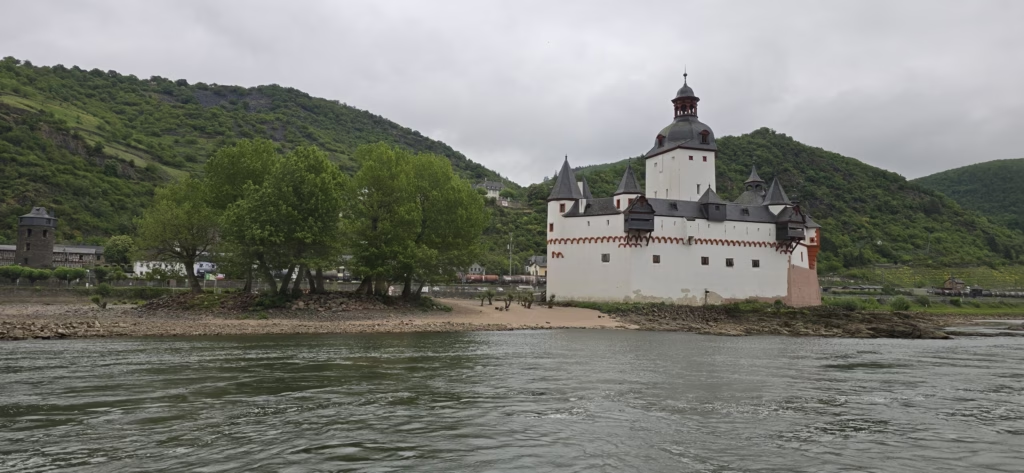
A few hundred meters past Kaub, the river opens around the Pfalzgrafenstein, a pentagonal white-and-red toll castle on a rock island called the Falkenau. This is the cruise’s visual peak. Ludwig der Bayer, then Pfalzgraf bei Rhein (Count Palatine of the Rhine, the regional sovereign) and later Holy Roman Emperor, raised the tower in 1326 to control toll collection at Kaub.[9] Pfalzgrafenstein is one of the only Rhine castles never destroyed in war (alongside the Marksburg downriver): damaged repeatedly by ice and current, never by Melac or Revolutionary troops. The signature white-and-red pointed prow facing upstream was added in 1606 and 1607 as ice-breaker and gun platform.
The pointed prow is why the castle looks like a ship floating against the current. A small Kaub-island ferry runs visitors out for self-guided tours in season; from the cruise deck you sail about 30 meters off the island’s stern.
Bacharach and Burg Stahleck, seen from water
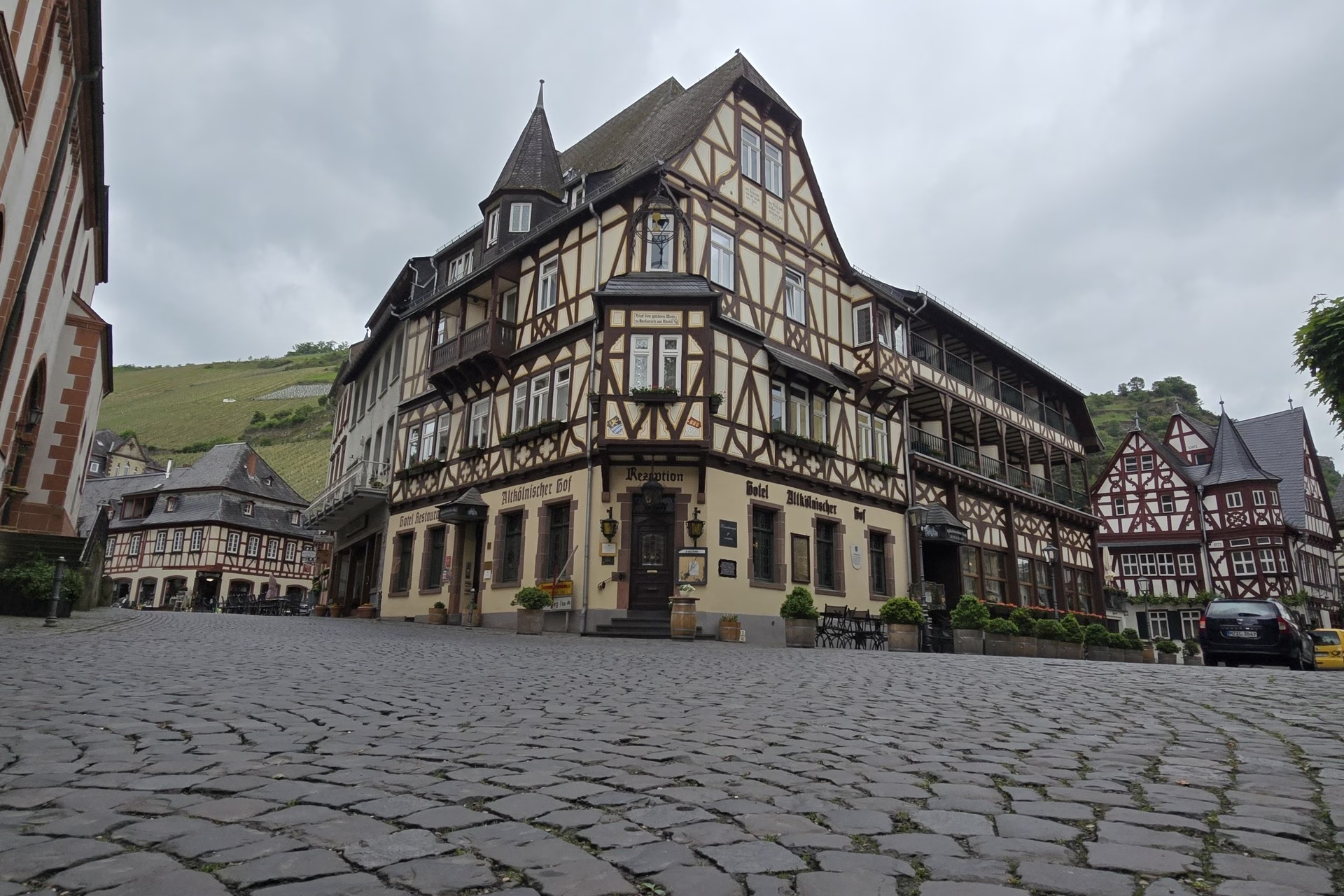
About 22 kilometers downstream from St. Goar, on the left bank, the half-timbered Altstadt of Bacharach appears with Burg Stahleck on the ridge above. We had walked Bacharach that morning (see Bacharach in Half a Morning, post 2), climbing partway up the Stahleck approach before turning back for the next train. From water level now, with rain darkening the slate roofs and the Wernerkapelle ruin a smudge above Oberstrasse, the town reads as one continuous medieval silhouette. Romantic-era painters who came down the Rhine after 1815 chose Bacharach for exactly this composition. The day’s loop closes on itself.
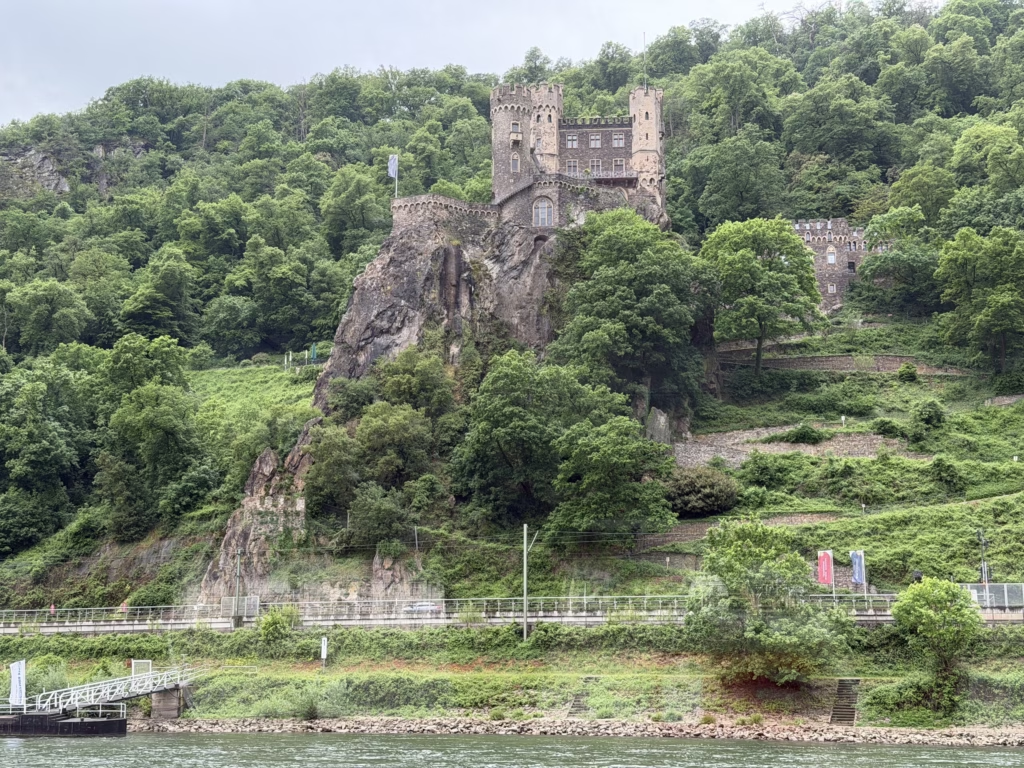
Burg Reichenstein at Trechtingshausen
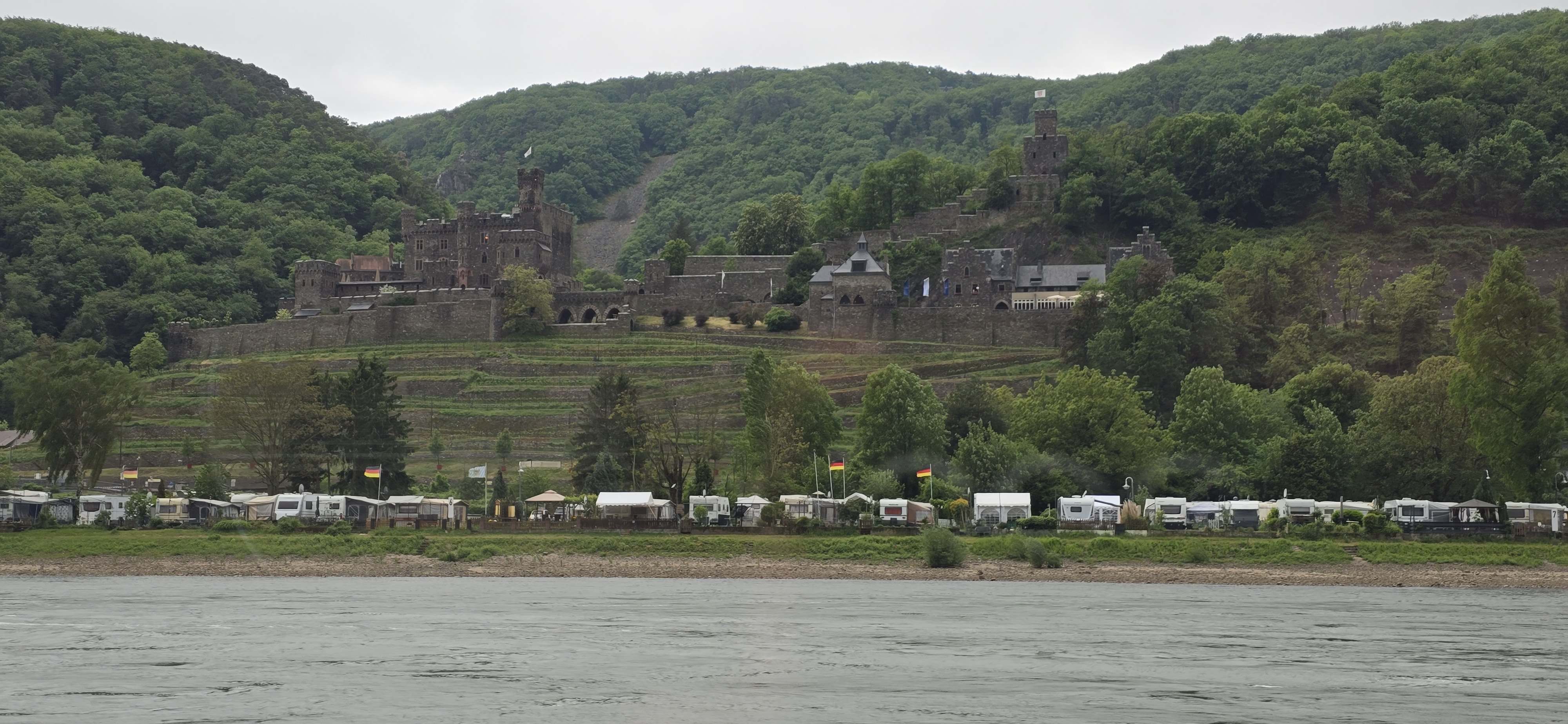
Five kilometers upstream of Bingen, above Trechtingshausen, the Tudor-Gothic profile of Burg Reichenstein comes into view. First documented in 1213 under a Bolanden castellan, it was destroyed by King Rudolf von Habsburg in 1282 as punitive action against Dietrich von Hohenfels (of the Hohenfels line of the Bolanden family), whose men had used it for Rhine piracy; Dietrich and his accomplices were beheaded at Trechtingshausen.[10][13] A 14th-century rebuild and final destruction in 1689 left it a ruin until 1834. The present silhouette is Baron Nikolaus von Kirsch-Puricelli‘s neo-Gothic Tudor reconstruction of 1899 to 1902, to plans by Regensburg architect Strebel. (The frequently repeated “Kuhn brothers” attribution belongs to Burg Rheinstein, two kilometers upstream, not Reichenstein.) Bought back in 2014 by Lambert Lensing-Wolff, a media entrepreneur descended from Kirsch-Puricelli, who runs a museum, hotel, and restaurant on site today.
Mauseturm and Burg Ehrenfels: arrival at Bingen
Three kilometers downstream of Reichenstein the river narrows toward the Binger Loch at the southern end of the gorge. The white crenellated Mauseturm appears on its small island mid-channel, and Burg Ehrenfels above the vineyards on the right (Hessian) bank. Both were paired across the river in the medieval toll system; the Mauseturm visible today is an 1855 neo-Gothic rebuild by Cologne Dombaumeister Ernst Friedrich Zwirner. (See Bingen as Rhine-Day Base Camp, post 1, for the full orientation.) The boat tied up at the Bingen KD Anlegestelle around 18:17 [primary-source: visited 2026-05-06]; from there it is a 30-minute walk to Parkplatz Fruchtmarkt and the car.
Where to eat and drink
The cruise is the meal pacing. The KD saloon carries coffee 3 EUR to 5 EUR, beer and wine by the glass 4 EUR to 7 EUR, and Brezel, Currywurst, and Wienerschnitzel with potato salad in the 8 EUR to 15 EUR range; card and cash both work. KD also runs dedicated dinner cruises with a fixed menu on selected sailings (separate booking); the 16:10 southbound is a transport-and-views run. If you have spent the morning in St. Goar Altstadt, consider bringing something onboard from Stefans Wein- und Weihnachts-Paradies [primary-source: visited 2026-05-06]. An open-deck pour as Pfalzgrafenstein passes starboard would be the cruise’s signature memory; we kept our bottle sealed as a keepsake and still rate the impulse as the right one for the day we had.
Practical tips
- The 20% rail-customer discount is booth-only. KD grants 20 percent off the standard fare to holders of a same-day DB ticket, BahnCard, Bahn-Pass, or Deutschlandticket. As of May 2026: KD’s English FAQ states “discounted tickets for rail customers cannot be purchased in the online shop, but only at the KD Office on site”.[11] We saved 20 percent on two one-way fares at the St. Goar booth on a same-day DB ticket [primary-source: visited 2026-05-06]
- Cover vs open deck is a deliberate choice in rain. Castles read better from the open deck without window reflection; the saloon is for the stretches between
- Rain is the Romantic feature, not the problem. 19th-century painters rediscovered this corridor because the light soft weather produces (low cloud, mist on the cliffs, the river going pewter) is the gorge’s signature
- Download the timetable before you go. The KD Rhine cruise castles timetable PDF is linked in Sources below; the 2026 season runs the Goethe daily except Mondays end-April through early October.[2]
- Verify the day’s last southbound. As of May 2026: the 16:10 was the last southbound on a Wednesday in early May; the schedule tightens at the shoulders of the season[2]
- From Bingen, allow 15 minutes to walk from the Anlegestelle to Parkplatz Fruchtmarkt in dusk or rain (5 minutes to Bingen Stadt)
- Language. German throughout, English at every booth and onboard
From the visit
Sources
- KD Koln-Dusseldorfer Deutsche Rheinschiffahrt AG, English-language portal. https://www.k-d.com/en/ (retrieved 2026-05-18).
- KD Rhine 2026 timetable (PDF). https://www.k-d.com/wp-content/uploads/2026/02/KD_Fahrplan_2026_web.pdf (retrieved 2026-05-18).
- KD Rhine, RMS Goethe fleet page. https://www.k-d.com/en/fleet/rms-goethe/ (retrieved 2026-05-18).
- Upper Middle Rhine Valley (Site 1066), UNESCO World Heritage Centre. https://whc.unesco.org/en/list/1066/ (retrieved 2026-05-18).
- Burg Maus, Wikipedia DE. https://de.wikipedia.org/wiki/Burg_Maus (retrieved 2026-05-18).
- Burg Katz (Neukatzenelnbogen), Wikipedia DE. https://de.wikipedia.org/wiki/Burg_Katz (retrieved 2026-05-18).
- T. J. Oakley Rhinelander, Wikipedia EN. https://en.wikipedia.org/wiki/T._J._Oakley_Rhinelander (retrieved 2026-05-18).
- Burg Gutenfels, Wikipedia DE. https://de.wikipedia.org/wiki/Burg_Gutenfels (retrieved 2026-05-18).
- Burg Pfalzgrafenstein, Wikipedia DE. https://de.wikipedia.org/wiki/Burg_Pfalzgrafenstein (retrieved 2026-05-18).
- Burg Reichenstein (Mittelrhein), Wikipedia DE. https://de.wikipedia.org/wiki/Burg_Reichenstein_(Mittelrhein) (retrieved 2026-05-18).
- KD Rhine, FAQ General (DB / BahnCard / Bahn-Pass / Deutschlandticket 20% discount at KD Office). https://www.k-d.com/en/faq-help/faq-general/ (retrieved 2026-05-18).
- Schonburg (Rhein), Wikipedia DE. https://de.wikipedia.org/wiki/Sch%C3%B6nburg_(Rhein) (retrieved 2026-05-18).
- Burg Reichenstein, regionalgeschichte.net (Institut fur Geschichtliche Landeskunde, Universitat Mainz). https://www.regionalgeschichte.net/mittelrhein/trechtingshausen/kulturdenkmaeler/burg-reichenstein.html (retrieved 2026-07-05).
- Burg Gutenfels, regionalgeschichte.net (Institut fur Geschichtliche Landeskunde, Universitat Mainz). https://www.regionalgeschichte.net/mittelrhein/kaub/kulturdenkmaeler/burg-gutenfels.html (retrieved 2026-07-05).