
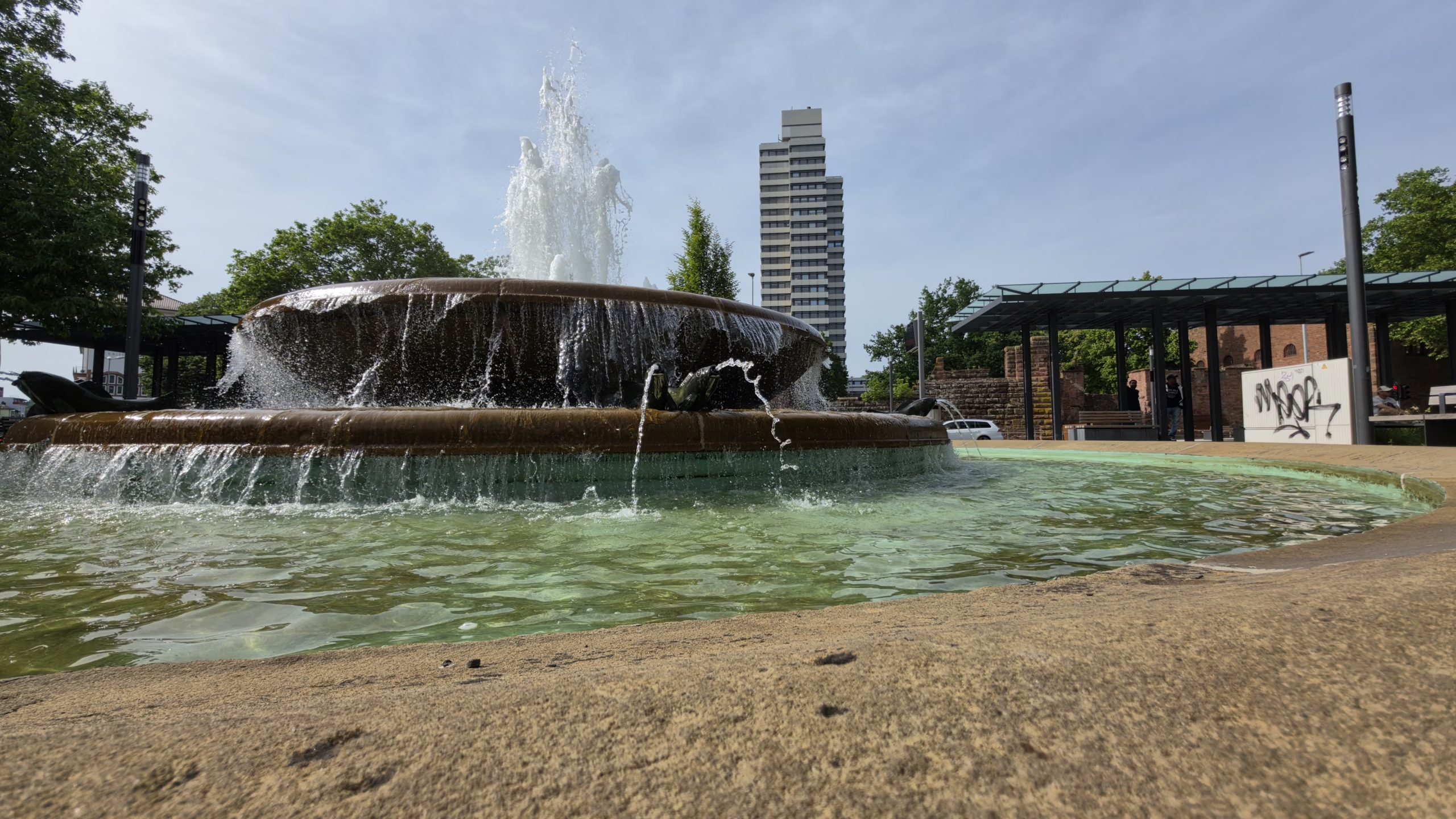
As of May 2026: Kaiserslautern 750 is well underway — the city’s 750th anniversary year. Oberbürgermeisterin (the mayor) Beate Kimmel opened the Jubiläumsjahr (the city’s 750th-anniversary year) at the Neujahrsempfang (New Year reception) on 12 January 2026, and the Kultursommer Rheinland-Pfalz officially launched the Kaiserslautern 750 public programme over the weekend of 1 to 3 May.[1][2]
I have lived in Rheinland-Pfalz since September 2018, first as an active-duty service member and then, since my January 2025 retirement, as a permanent-resident American household. This page is my attempt to cover what Kaiserslautern 750 means for the city Americans like me walk through every day, from Rudolf von Habsburg’s 1276 Stadtrecht (medieval town-charter rights bundle) to the 2026 Jubiläumsprogramm (anniversary-year programme).
This is for Americans living in or near Kaiserslautern who recognize the Stiftskirche (the medieval collegiate church on the central square), the Fruchthalle (the 19th-century neo-Renaissance concert hall), Vogelweh (the postwar US military housing enclave on the city’s western edge), and the Fußgängerzone (the pedestrian-only shopping street running west from the Stiftskirche), but who have never had the Kaiserslautern 750 frame stitched together in English. It is reflective rather than touristy. If you have been here three years or thirty, the goal is to make a familiar city legible.
Last reviewed: May 2026
Not professional advice. This page reflects one American-German family’s reading of Kaiserslautern’s history and the 2026 Jubiläumsprogramm. It is not professional historical, legal, civic, or tourism advice. Cross-check specific event dates, opening hours, and the official Kaiserslautern 750 programme directly against the cited primary sources (Stadt Kaiserslautern Chronik, 750kl.de, Wikipedia DE) before acting on anything here.
From Lutra to Lautern: The Settlement Before the City
As of May 2026: the pre-1276 history sketched below is drawn from the Stadtchronik (the official city chronicle) maintained by the Stadt Kaiserslautern and from the Wikipedia DE main article on the city’s history. These two sources agree on the major dates.
The settlement was here long before any king put a charter on it, and the Kaiserslautern 750 anniversary year is measuring from a charter, not from first habitation. Neolithic Bandkeramiker farmers occupied the slopes north of the Lauter river in the 6th and 5th millennium BC, leaving pottery and post-hole evidence of grain-storage houses that turned up during excavations on the Rittersberg in the early 1990s.[3] A Roman presence followed, traces of it sit directly under today’s Stiftskirche, though archaeologists still cannot tell whether the site was a villa rustica or a road station on the via regalis, the Metz-to-Mainz military road that ran roughly where the Bundesstraße 40 does now.[3]
The name first surfaces in writing around 830 AD, when the place appears in the Lorscher Reichsurbar as villa Luthra, a Frankish royal estate with a market and toll rights.[4] The root is the Old High German lûttar meaning “clear, bright,” paired with aha for “water,” because of the small Lauter river that once ran openly through the centre of town and now flows under the Fußgängerzone in a culvert. By 985, Emperor Otto III had handed curtis Luthara and the surrounding Wasgauforst to his Salian cousin Otto von Kärnten — and by that point the estate already carried Markt- und Bannrechte: the right to hold a market, plus the royal Bann, the king’s authority to enforce penalties and summon people to court.[3]
The Hohenstaufen layer is the one that left the city its informal name. Between 1152 and 1158, Friedrich I, called Barbarossa, ordered the existing Salian castle on the Rathaus site rebuilt into a proper imperial pfalz “with no small splendour,” summoned Premonstratensian canons to staff a new hospital, and made Lautern a node in the Staufer power circuit through the Pfalz region.[4]
This is the reason every tourism brochure for the next 870 years has called Kaiserslautern the Barbarossastadt, and why the Kaiserslautern 750 visual programme keeps coming back to the Staufer layer. Friedrich himself is documented as visiting in 1158, and several Staufer emperors after him used the pfalz over the following decades. King Richard of Cornwall married Beatrix von Falkenburg here in 1269, seven years before Rudolf of Habsburg made the next, decisive move.[1]
1276: What Rudolf von Habsburg Actually Granted
As of May 2026: the legal-historical content in this section is taken from the Stadt Kaiserslautern Chronik (a primary civic source) and from Wikipedia DE’s Stadtrecht article and Rudolf I (HRR) article.
On 18 August 1276, König Rudolf von Habsburg issued a charter granting Lautern “the rights and freedoms of the imperial city of Speyer” (die Rechte und Freiheiten der Reichsstadt Speyer).[1][5] That phrasing matters. Stadtrecht in the Holy Roman Empire was not a single statute but a bundle: a Marktrecht (market right), a Befestigungsrecht (the right to build and maintain city walls), a limited Ratsverfassung (a council government), and immunities from various forms of seigneurial interference.[5]
By tying Lautern to Speyer’s existing rights, Rudolf was not inventing law from scratch; he was making Lautern a member of the Speyer Stadtrechtsfamilie (the Speyer legal lineage, a family of cities all governed under the same charter rights), one of the recognized medieval German legal lineages.
1276 was a busy year for Rudolf’s city policy in general. The Wikipedia DE biography notes that of the 2,223 charters issued under his reign, 662 went to cities and 222 distinct cities ended up among the recipients.[6] He was using the Reichsstädte (civitates imperii) deliberately, as financial and military counterweights to the bishops and territorial princes who had grown strong during the Interregnum. Lautern’s elevation slotted into that programme. Within a decade the Franciscans had founded a monastery (1284), and shortly after 1300 the first proper city wall went up.[1]
The detail to hold onto is that 1276 is not the city’s founding date. The settlement is at least four centuries older than the charter. What the charter did was give Lautern legal personhood inside the imperial system, the right to govern itself in certain matters, hold its own markets, defend its own walls, and answer to the king rather than to a local lord. That is the moment the Kaiserslautern 750 anniversary year is measuring from.
1276 is not the city’s founding date. The settlement is at least four centuries older than the charter.
From Reichsstadt to Pawn: 1313 to 1571
As of May 2026: the territorial and dynastic history in this section follows the Wikipedia DE main article and the Stadtchronik.
The Reichsstadt status did not last long, which is why the middle of the Kaiserslautern 750 arc is dominated by territorial princes rather than imperial autonomy. By 1313 or 1314, the city had been pledged (verpfändet) to Graf Georg von Veldenz and Gottfried von Leiningen as collateral against royal debts. In 1322, Emperor Ludwig the Bavarian pledged Lautern again, this time to King Johann von Böhmen, and the pledge charter contains the first surviving written form of the German name Keyserslûtern, “Caesar’s Lautern.”[4][1] The “Kaiser” prefix is, in other words, a 14th-century bookkeeping byproduct of the city being put up as imperial security.
After a series of further pledges, Lautern was ceded to Kurfürst (prince-elector of the Holy Roman Empire) Ruprecht I of the Pfalz in 1357 and from 1375 onward functioned as a Kurpfälzisches Oberamt (an Electoral-Palatinate district seat), an administrative seat inside the Electoral Palatinate.[4] The Reichsstadt era was effectively over by the time the Black Death generation had aged out of city life. Any Kaiserslautern 750 timeline must reckon with this: the city spent more of its 750 years under territorial rule than as an independent Reichsstadt. The pattern (free imperial status, then collateral, then absorption into a larger territorial principality) was common across the Reich; very few small Reichsstädte made it to 1803 with their imperial immediacy intact.
In 1510, the city government restructured itself, adding a Gemeinderat (a broader municipal council) drawn from the guilds alongside the existing Rat (the older patrician council), and in 1510 or 1511 the old Premonstratensian foundation was secularised into a worldly Chorherrenstift (a collegiate church of canons, no longer monastic).[1] After 1571, Pfalzgraf (count palatine, the ruling prince of the Palatinate) Johann Casimir, the “Jäger aus Kurpfalz” (the Huntsman from the Electoral Palatinate, his folk nickname), built a Renaissance Schloss next to the surviving Barbarossa pfalz, signalling the city’s role as a residenz for the Pfalz-Lautern cadet branch.[4]
Three Wars, Three Catastrophes: 1621 to 1703
As of May 2026: dates and events drawn from the Stadtchronik and Wikipedia DE; I have been particularly careful here because the destruction-date discipline matters for any post that touches Pfalz castles or cities.
The 17th century is the dark middle of the Kaiserslautern 750 timeline and broke the city repeatedly. During the Thirty Years’ War, the Spanish occupied the city in 1621 and the Swedes in 1632.[1] The worst single event was 17 July 1635, the so-called Kroatensturm (literally the “Croat storm”, the imperial-cavalry raid that sacked the city), when imperial troops (the term Kroaten is used generically in the chronicles for the irregular cavalry under Habsburg service) stormed the city and conducted what the Stadt’s own chronicle calls a Blutbad, a bloodbath, among the civilian population.[1] Population estimates for the city after 1648 are a fraction of what they had been a generation earlier.
The French came next. In 1688, the start of the Pfälzischer Erbfolgekrieg (the Nine Years’ War, 1688 to 1697), French forces occupied the city.[1] Then in 1703, during the Spanischer Erbfolgekrieg (the War of the Spanish Succession, 1701 to 1714), they returned and this time blew up both the Barbarossa pfalz and the Casimirschloss, which is why what stands behind the Rathaus today is a fragment, not a castle. This date distinction matters for the Kaiserslautern 750 history: 1689 is the destruction year for many Pfalz castles further south (Madenburg, Wasgau ridge fortresses), but Kaiserslautern’s castle complex was destroyed in 1703 during a separate war.[4][1]
The 18th century brought a brief intellectual flourish (the Physikalisch-Ökonomische Gesellschaft was founded in 1768, becoming the Hohe Kameral-Schule in 1774 before being moved to Heidelberg in 1784) and another French occupation, this one permanent. With the Peace of Lunéville in 1801, the left bank of the Rhine became legally French territory; Kaiserslautern was an Unterpräfektur of the French department of Mont-Tonnerre until 1814.[4]
Bavarian Pfalz, Pfaff, and the 1849 Aufstand
As of May 2026: the 19th-century material is drawn from the Stadtchronik, the Pfaff Wikipedia DE entry, and the Wikipedia DE city history.
The 1816 Congress of Vienna handed the Pfalz to Bavaria, and Kaiserslautern became the seat of the regional Bavarian government for what was now called the Rheinkreis (later the Pfalz).[1] The mid-19th century is when the recognizable shape of the modern city emerged, the chapter of the Kaiserslautern 750 story that most directly produced the streetscape Americans walk today. Anyone reading the Kaiserslautern 750 history from inside the city centre is mostly reading 19th-century decisions about the 19th-century built environment, not medieval ones.
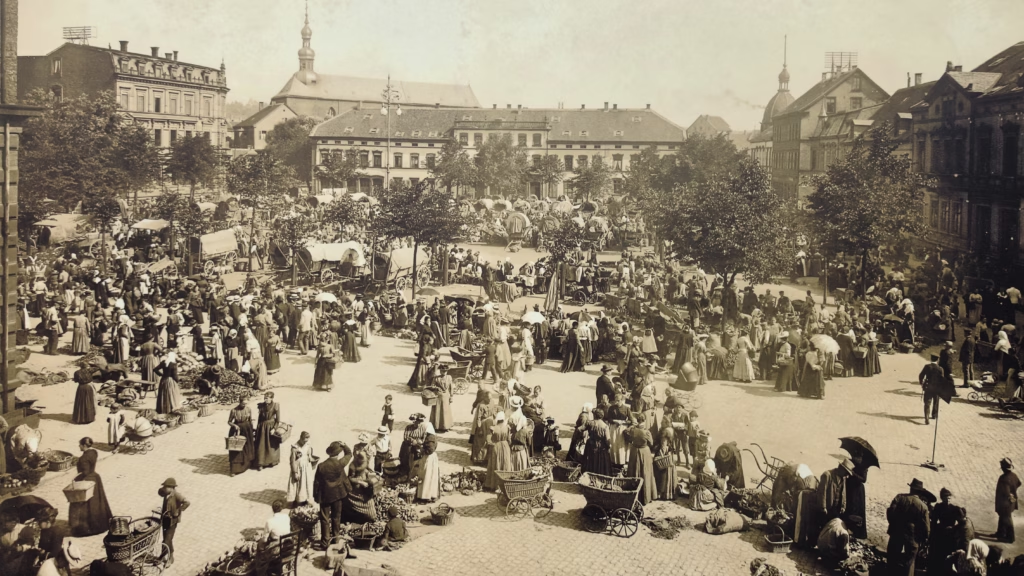
The railroads arrived early: the line to Bexbach opened in 1848, the line to Ludwigshafen in 1849.[1] That connectivity made the Industrialisierung possible. The Kammgarnspinnerei was founded in 1857, and in 1862, the instrument-maker Georg Michael Pfaff sold “his first” sewing machine, the one now displayed in the Deutsches Museum in Munich.[7] Within a decade, Pfaff had pivoted out of brass instruments entirely and built what became one of Germany’s leading sewing-machine manufacturers; by 1891, 400 workers were producing roughly 25,000 machines a year, and by 1913, 60 percent of production by volume was exported.[7] The current Pfaff industrial site on the Galgenberg dates from the 1894 to 1906 relocation off the original Friedrichstraße works.
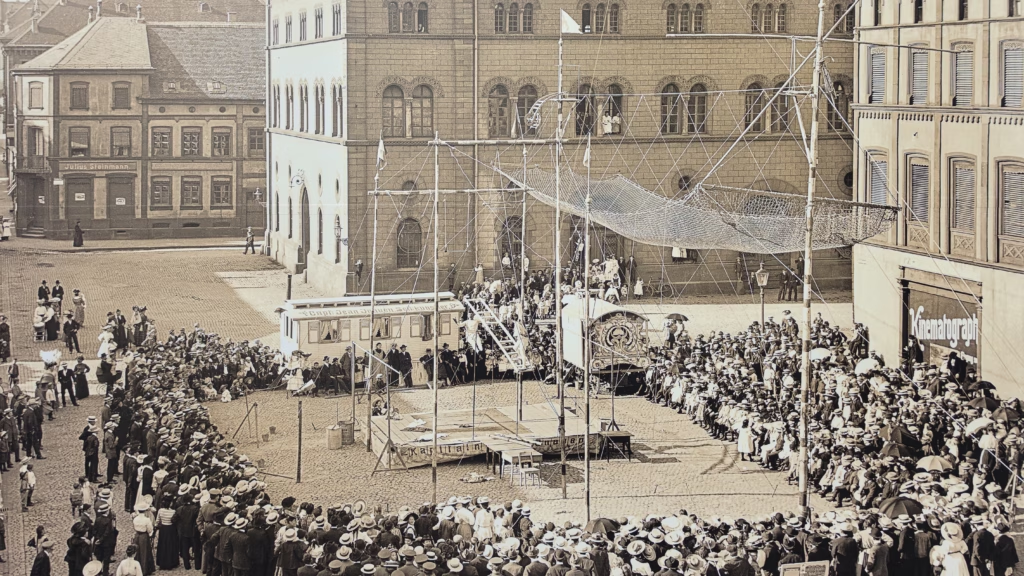
Between the railroads and the industry came the politics. In May and June of 1849, in the wake of the failed 1848 revolution, the Pfalz rose against Bavarian rule. A Provisorische Regierung der Pfalz convened in the Fruchthalle and declared the Pfalz independent of Bavaria.[1][4] The rising was suppressed within weeks by Prussian troops, who entered the city in mid-June 1849, but the Fruchthalle has carried that political weight ever since. The building itself, designed by August von Voit and built between 1843 and 1846, is where King Ludwig I of Bavaria first publicly called the city “Barbarossastadt” at the cornerstone-laying ceremony in 1843.[1]
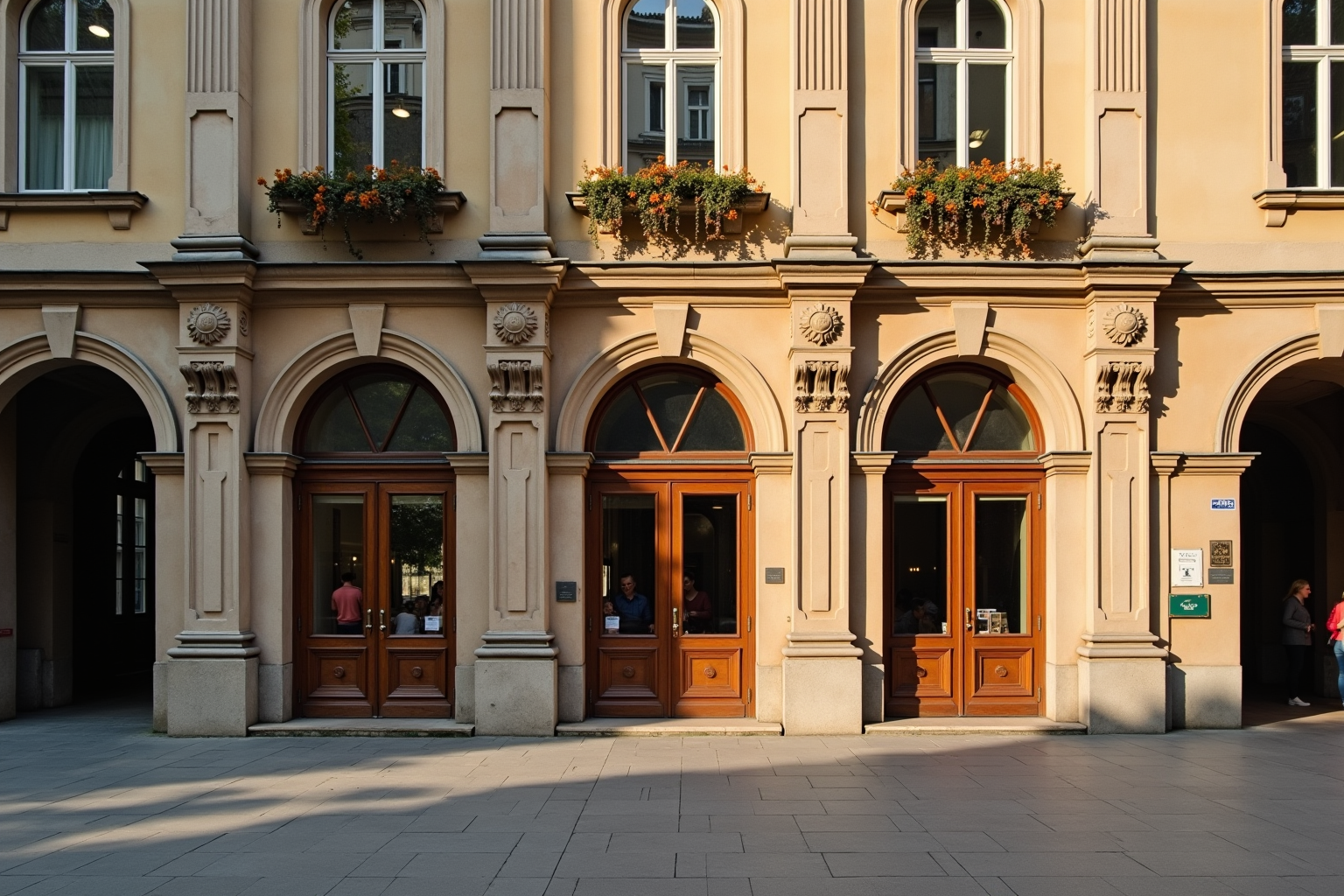
Bombs and the End of the War: 1940 to 1945
As of May 2026: dates from the Stadtchronik and the Wikipedia DE city article.
The first World War II air raids hit the city in 1940.[1] Multiple major raids during 1944 and 1945 destroyed the bulk of the inner city; the standard summary in both the civic chronicle and Wikipedia DE is weitgehend zerstört, “largely destroyed.”[1][4] Pfaff’s main plant lost an estimated 60 percent of its built area in a single 1944 bombing raid.[7]
American troops took the city on 20 March 1945 as part of Operation Undertone, the Seventh Army’s drive into the Saar-Palatinate.[4] For Kaiserslautern, the war ended that day. The civilian death tolls from the 1944 to 1945 raids are still debated in local historiography, but the physical scale of the destruction is the reason the centre looks the way it does today: the postwar rebuild was deliberately verkehrsgerecht, oriented toward the car, which is why the Maxstraße and the inner ring roads cut the geometries they do.[4] Any honest Kaiserslautern 750 narrative has to count those 1945 raids as one of the breaks in the city’s 750-year arc, not as a footnote.
The American Chapter: 1945 Onward
As of May 2026: the postwar period and KMC framing draw on Wikipedia DE’s KMC article and Stars and Stripes Europe’s anniversary coverage.
The city sat inside the French occupation zone after the war, and the new Land Rheinland-Pfalz was constituted in August 1946 by decree of the French military governor.[4] American forces arrived as the long-term garrison shortly after, and over the following decade the Kaiserslautern Military Community took shape: Vogelweh as the main housing area, Kleber, Daenner, Panzer and Pulaski Barracks inside or adjacent to the city, Ramstein Air Base eleven kilometres west in Ramstein-Miesenbach, and Landstuhl Regional Medical Center on the ridge above the town of Landstuhl.[8] A retired American household that stays in the KMC after active service (see my own Pink Card retiree-customs situation) lives the Kaiserslautern 750 story from inside the latest chapter rather than as a visitor.
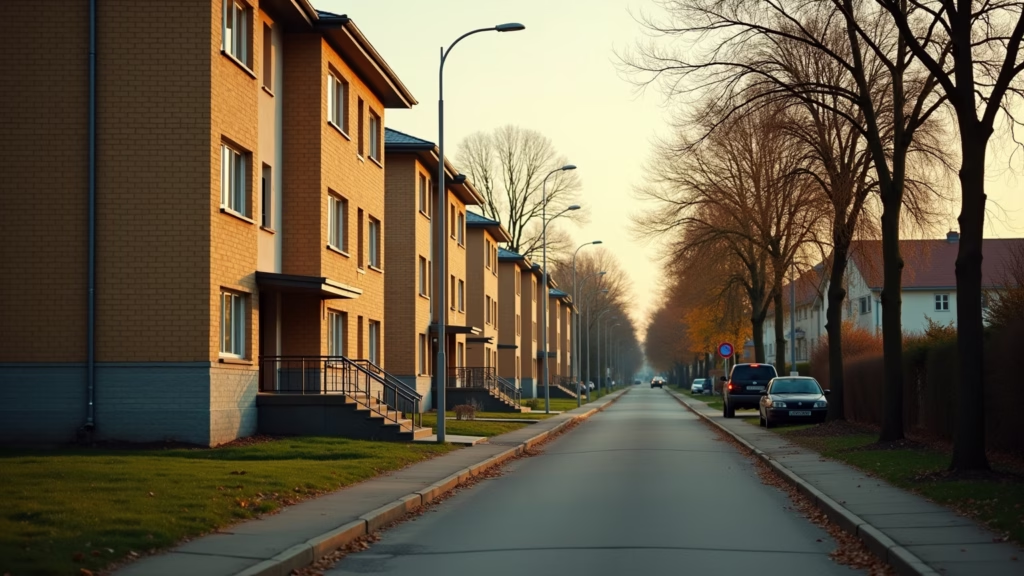
By 2020, KMC counted roughly 40,000 US military-affiliated personnel, making it the largest US garrison outside the United States, with annual economic contribution to the local region documented at 2.07 billion dollars as of fiscal year 2010.[8] The 2009 opening of the Kaiserslautern Military Community Center (KMCC) on Ramstein, with what is still the largest AAFES retail footprint worldwide at roughly 50,000 square metres, is the most visible single piece of American infrastructure in the region.[8] That AAFES footprint is one of the youngest layers in the Kaiserslautern 750 timeline, and one of the largest by physical area.
Honest framing: the American chapter is roughly 80 of the city’s 750 years, a little over 10 percent of the documented arc. We are recent, not foundational. The 14 November 1956 crash of a US Air Force F-86 jet into the Bezirksamt on the corner of Burg- and Maxstraße (three dead, the pilot and two civilians) is one of the entries in the Stadtchronik where the American presence intersects local civic memory directly.[1][4]
Most of the rest of the American imprint in the Kaiserslautern 750 story is quieter: the bilingual signage at the Hauptbahnhof, the Pfalz-Express newspaper that gets distributed at the gates, the Frühschoppen culture that built up around installations like Vogelweh in the 1960s and 1970s, the fact that any Saturday on the Schillerplatz you can hear English, Spanish, Tagalog, and German in the same fifteen-minute span.
I would not write a Kaiserslautern 750 pillar without noting that the 2026 Jubiläumsprogramm explicitly includes the Deutsch-Amerikanische Freundschaftstage as a recognized highlight on the city’s own list,[9] which is the official civic acknowledgment that the American chapter is part of what the city is now choosing to mark. The framing I find most honest is one Oberbürgermeisterin Kimmel used in her 12 January Neujahrsempfang remarks: Kaiserslautern as a city shaped by kulturelle Vielfalt and internationale Prägung.[2]
The 2026 Kaiserslautern 750 Jubiläumsprogramm: What’s Actually Happening
As of May 2026: the programme below is current as of the 750kl.de event calendar as last fetched on 21 May 2026. This section will be the first to age. Treat any specific event date below as “verify on the 750kl.de calendar before you go.”[2]
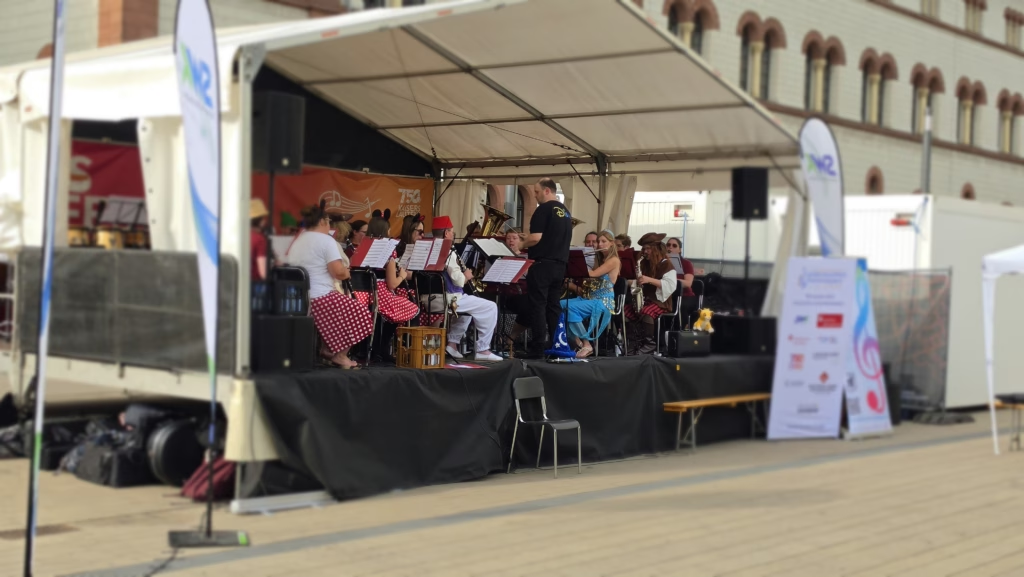
The civic framing the city chose for the Kaiserslautern 750 year is “Kurze Wege. Lange Geschichte.” (short paths, long history), with the hashtag #750KL and the slogan Wir sind Lautern.[9] There is no single central Festakt; Citymanagement leader Alexander Heß has said publicly that the goal is many smaller, targeted events rather than one big stage moment, in part to benefit local retail and gastronomy.[10]
The visible programme so far includes:
- Neujahrsempfang, 12 January, Fruchthalle. Around 700 guests; Kimmel formally opened the Jubiläumsjahr.[2]
- Sinfoniekonzert “Jupiter / Ethel / Manfred”, 16 January, Fruchthalle. Pfalzphilharmonie under Agata Zając, programmed around women in the orchestral canon.[2]
- Food & Art Festival, 27 to 29 January, Innenstadt. Ten local organizers, sustainability framing.[2]
- Kultursommer Rheinland-Pfalz opening, 1 to 3 May. A Kulturmeile from Schillerplatz to the Pfalzgalerie, programmed under the theme
Die Goldenen Zwanziger. The opening 30,000-copy programme booklet (designed by the Kaiserslautern agency PEAKS) is distributed through the Rathaus, Tourist Information, and local gastronomy.[11][2] - Jubiläumsbühne am Stiftsplatz, 8 to 24 May. The permanent jubilee stage opens in May at the Stiftsplatz, then relocates to the Schillerplatz in August or September.[2]
- Festkonzert “750 Jahre Kaiserslautern”, 26 June, Fruchthalle. Programmed as the headline civic concert.[2]
- Deutsch-Amerikanische Freundschaftstage (held 5-7 June 2026 on the John-F.-Kennedy-Platz in Ramstein-Miesenbach).[9][10]
- Festgottesdienst in the Stiftskirche and kulinarische Wanderung auf den Humberg are both on the civic press office’s highlight list.[9]
- Filmisches Stadtporträt by SWR’s Bernd Schmitt, plus a Bildband and a Bildkalender of historic city views from the Kulturreferat.[9]
- Stadtmuseum exhibition and Tourist Information Jubiläumsstadtführungen running through the year.[9]
Stars and Stripes Europe has been reporting the Kaiserslautern 750 anniversary for an American military readership; their April 2026 article notes the “Fishing for Fantasy” project (the ten painted civic fish statues), originally a 2001 piece of public art, returning for the Jubiläum, plus a 1230-dated golden-ring legend tied to the pike on the city’s coat of arms.[12] If you have walked past one of the painted fish in the Fußgängerzone and wondered what you were looking at, that is the connection.
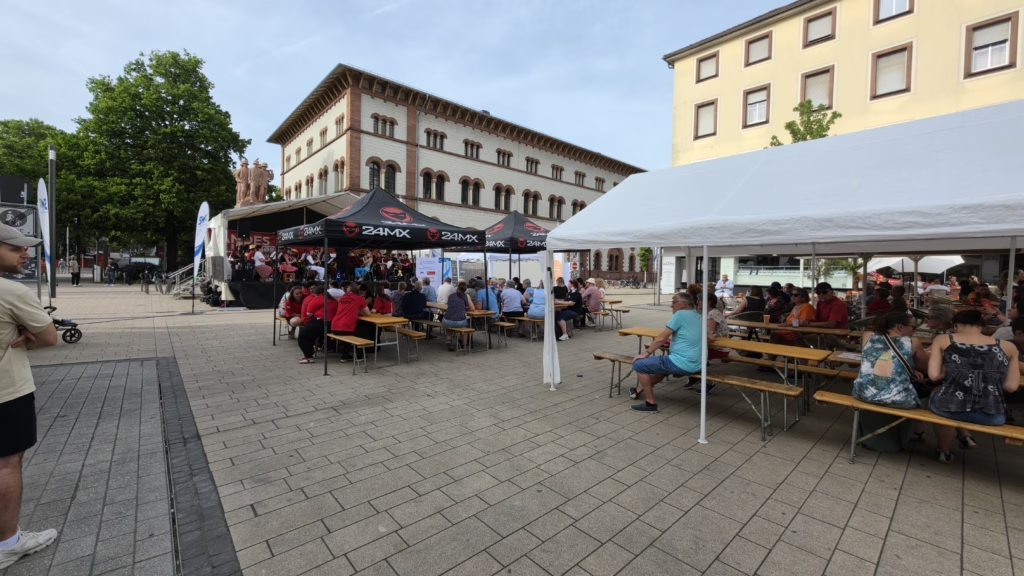
Walking Kaiserslautern 750 Years Today
As of May 2026: this section is observational rather than regulated; it ages only if buildings change.
Once you have the Kaiserslautern 750 timeline in your head, several familiar pieces of the city stop being decorative and start being legible. The same shift happens with regional landmarks the KMC orbit absorbs by default, like the Europa-Denkmal at Sankt Germanshof on the Wasgau ridge. A short list of the Kaiserslautern 750 cues I keep noticing on my own walks through the city centre:
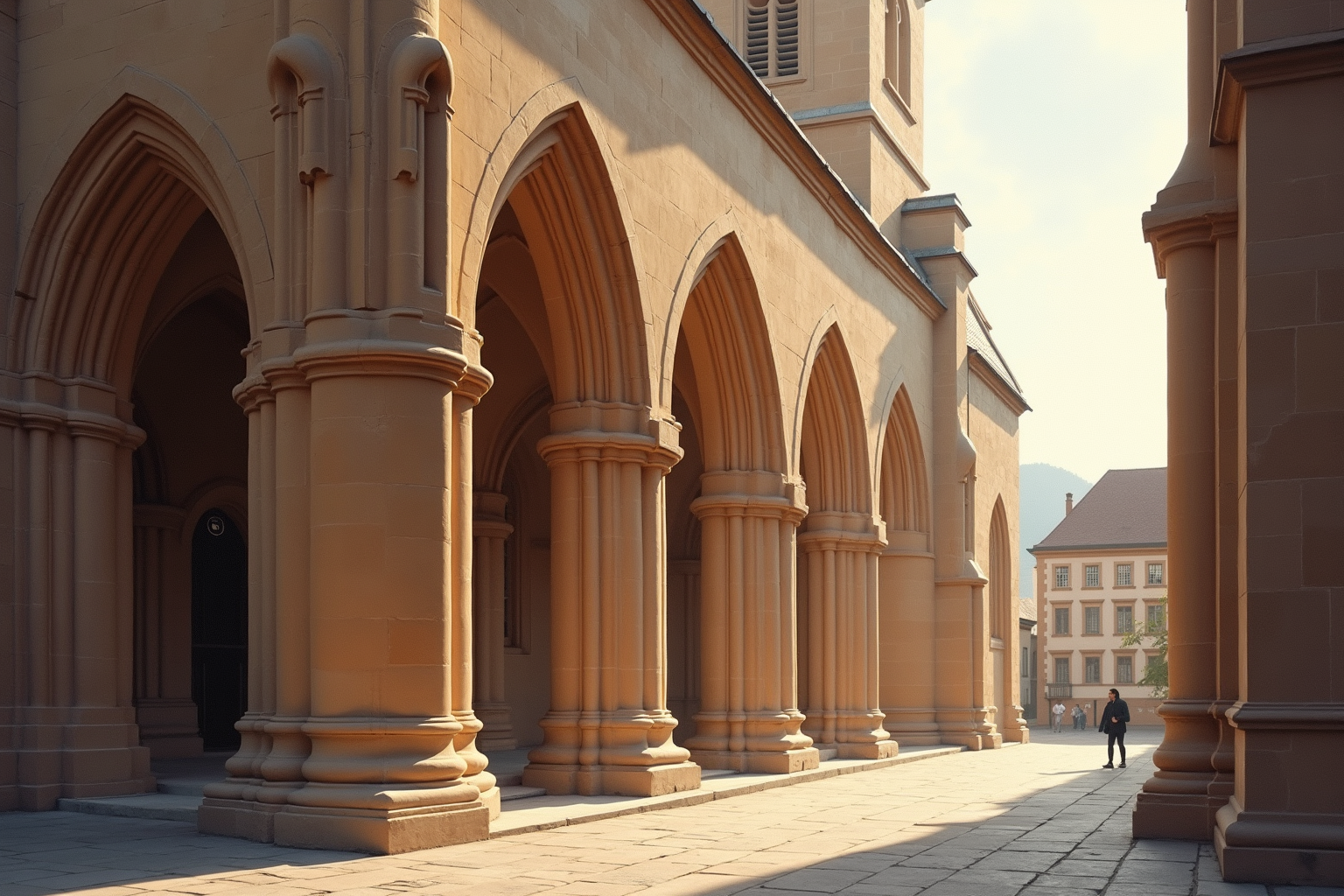
- The Stiftskirche. The early-Gothic choir was begun around 1260, sixteen years before the Stadtrecht. The Roman foundations underneath it predate the medieval church by roughly a thousand years, which is why the Stiftskirche is the longest continuously legible point on the Kaiserslautern 750 timeline.[4]
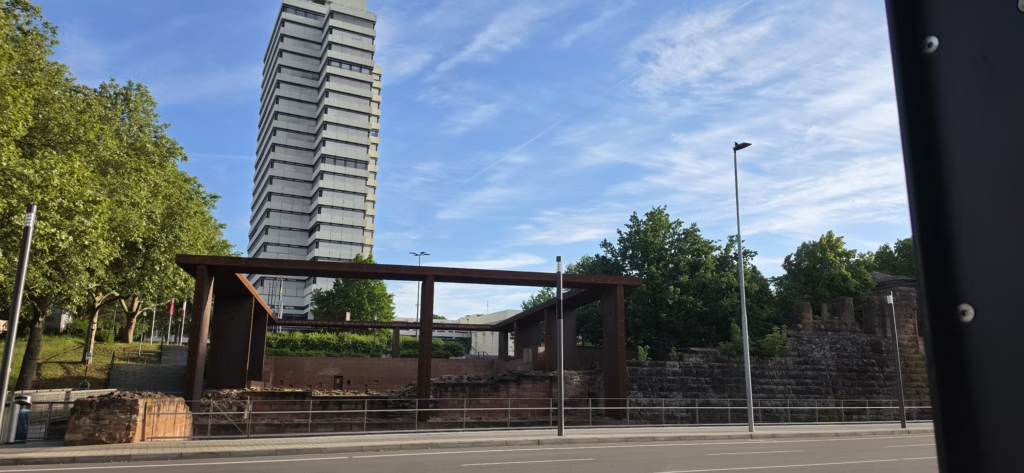
- The Rathaus square and the Burgruine. What sits behind the modern Rathaus is the surviving fragment of the Barbarossa pfalz and the Casimirschloss, both blown up by French troops in 1703.[1]
- The Fruchthalle. Built 1843 to 1846, named “Barbarossastadt” by Ludwig I at the cornerstone-laying, seat of the 1849 Provisorische Regierung der Pfalz, and host of the 12 January 2026 Neujahrsempfang that opened the Jubiläumsjahr.[1][2]
- The Lauter river. Now culverted under the Fußgängerzone. The reason there is a city here in the first place and the etymological root of every Kaiserslautern 750 reference on the city’s own materials.
- The Pfaff industrial complex on the Galgenberg. The 1894-to-1906 relocation; you can still see the original brick edifice from the K in Lautern parking deck if you know what you’re looking for.[7]
- Vogelweh. Postwar US military housing area, not original to the prewar city plan; visible on any map as the rectangular enclave on the western edge.[8]
- The painted fish statues. “Fishing for Fantasy”, 2001 originally, revived for 2026 as part of the Kaiserslautern 750 visible-art programme.[12]
- The Maxstraße ring. Postwar
verkehrsgerechtplanning, which is why traffic patterns feel American-suburban in places where they “should” feel medieval. The 1945 fracture is the most physically visible chapter of the Kaiserslautern 750 timeline.[4]
Sources
These primary and secondary sources underpin the Kaiserslautern 750 history above. The civic ones (Stadtchronik, 750kl.de) are the most authoritative for the 2026 programme; Wikipedia DE provides the connective tissue, with primary citations verified inline where dates or names matter.
- Stadtchronik Kaiserslautern, offizielle Chronik der Stadt, kaiserslautern.de/sozial_leben_wohnen/stadtportrait/stadtgeschichte/chronik/ (retrieved 2026-05-21).
- 750KL Veranstaltungskalender, offizielle Jubiläums-Eventlisten, 750kl.de/veranstaltungen (retrieved 2026-05-21).
- Geschichte der Stadt Kaiserslautern, Wikipedia DE, de.wikipedia.org/wiki/Geschichte_der_Stadt_Kaiserslautern (retrieved 2026-05-21).
- Kaiserslautern, Wikipedia DE Hauptartikel, de.wikipedia.org/wiki/Kaiserslautern (retrieved 2026-05-21).
- Stadtrecht, Wikipedia DE, de.wikipedia.org/wiki/Stadtrecht (retrieved 2026-05-21).
- Rudolf I. (HRR), Wikipedia DE, de.wikipedia.org/wiki/Rudolf_I._(HRR) (retrieved 2026-05-21).
- Pfaff (Unternehmen), Wikipedia DE, de.wikipedia.org/wiki/Pfaff_(Unternehmen) (retrieved 2026-05-21).
- Kaiserslautern Military Community, Wikipedia DE, de.wikipedia.org/wiki/Kaiserslautern_Military_Community (retrieved 2026-05-21).
- 750KL Jubiläumsjahr-Framing, 750kl.de/jubilaeum (retrieved 2026-05-21).
- Pressemitteilung Nr. 079245, Stadt Kaiserslautern, “750-Jahr-Feier nimmt Fahrt auf,” kaiserslautern.de/buerger_rathaus_politik/medienportal/pressemitteilungen/079245/ (retrieved 2026-05-21).
- Kultursommer-Eröffnung 2026 in Kaiserslautern, “Die Goldenen Zwanziger,” 750kl.de/kultursommer-eroeffnung (retrieved 2026-05-21).
- “Kaiserslautern celebrates its 750th anniversary,” Stars and Stripes Europe, 20 April 2026, europe.stripes.com/your-community/kaiserslautern-750th-anniversary.html (retrieved 2026-05-21).