We drove up to the St. Beatus Caves on Lake Thun on a quiet Friday morning in December 2023 with no plan and no booking. We didn’t know the dragon legend, didn’t know the chapel history, didn’t know how long the cave tour takes. We saw a place with a waterfall and a view of Lake Thun on the map, four-and-a-half kilometres from where we’d parked our caravan, and drove up to see what was there.
What we found was the cave closed for off-season renovation – no advance notice we’d caught, no sign visible from the road, just a locked entrance and the cliff path empty. We stayed about forty minutes anyway, walked the outdoor grounds, took family photos at the entrance terrace and the stone arches, and left. This guide is what I wish I had read before driving up – the history, the seasonal-closure trap, and what the outdoor grounds actually give you when the cave itself is locked. Like our anniversary weekend on the Rhine, the trip was a deliberate low-pressure weekend; an unexpected closure didn’t sour it, and it doesn’t have to sour yours.
Visit at a glance
- Official site: beatushoehlen.swiss (St. Beatus-Höhlen operator)
- Address: St. Beatus-Höhlen, 3800 Sundlauenen, Switzerland
- Opening hours: Caves daily April–October; closed November–March for winter renovation
- Parking: Cave-lot paid (CHF 5–8/day); waterfall viewpoint always accessible
- Cost: Adult CHF 22, child CHF 13; closed-season waterfall walk free
- Accessibility: Cave tour has stairs and uneven terrain; not wheelchair accessible; waterfall lookout level
- Distance from Kaiserslautern: ~480 km, ~5–6 h via A5 → A6 (CH) → A8
- Time on site: 60–90 min guided cave tour; 20–30 min waterfall lookout when closed
A bit of history: Beatus, the dragon, and the cave pilgrims
The cave takes its name from Saint Beatus of Lungern, an early Christian hermit whose legend places him here as the first apostle to Switzerland. According to tradition, Beatus arrived from Ireland by way of Rome, settled in a hermitage above Lake Thun, and drove a dragon from the cave. Beatus then lived out his life in the cave, and his grave is still shown at the entrance.[3] None of this was on our radar when we drove up; we picked up the legend reading about the place afterward.
Historians are gentler with the chronology. The earliest written accounts of Beatus date no earlier than the 10th and mid-11th centuries, and the figure was probably conflated with a 9th-century Abbot Beatus who received a charter from Charlemagne for Honau Abbey.[3] The cave itself is real, and so is the pilgrimage that grew up around it: by the Middle Ages a small pilgrimage chapel inside the cave operated in honor of Saint Beatus under the supervision of Kloster Interlaken.[4]
What happened next is a Reformation-era story that takes some unpacking. In 1528 the Bern government had the chapel torn down and the cave entrance walled up to stop the pilgrimages. The Catholic Unterwaldner (residents of canton Unterwalden, central Switzerland, on the south side of the lake) broke the wall open. Bern walled it up again, the Unterwaldner broke it open again, and the cycle repeated.
As a counter-cult, Bern built an evangelical-reformed church on Beatenberg above the cave in 1534–35.[4] Beatus’ relics eventually moved to the chapel at Lungern in Obwalden, but the mountain still carries his name.[3] The Beatus cave shares a shape with other late-medieval pilgrim sites along the European trade routes; the Rhine wine-town of Bacharach, for instance, grew up around the Werner-chapel pilgrimage of the late 13th century, another medieval site of similar shape.
The cave was reopened to the public only in 1904, after centuries of Reformation-era quiet.[5] Today the Beatus-Höhlen-Genossenschaft, the operating co-operative, has explored 14 km of the cave system, of which 1 km is illuminated, secured, and walkable.[1] The cave runs a constant 8 to 10 °C year-round with around 95% humidity, which means the underground experience in December is identical to July – though the operator’s closure calendar makes that less of an all-year promise than it sounds.[2]
When St. Beatus Caves Lake Thun is closed: the outdoor grounds
This is the section I wish someone had written before we drove up – what’s actually here when the cave entrance is locked. The short answer: enough for forty unhurried minutes with a family, and a few of the strongest photo positions on the north shore of Lake Thun.
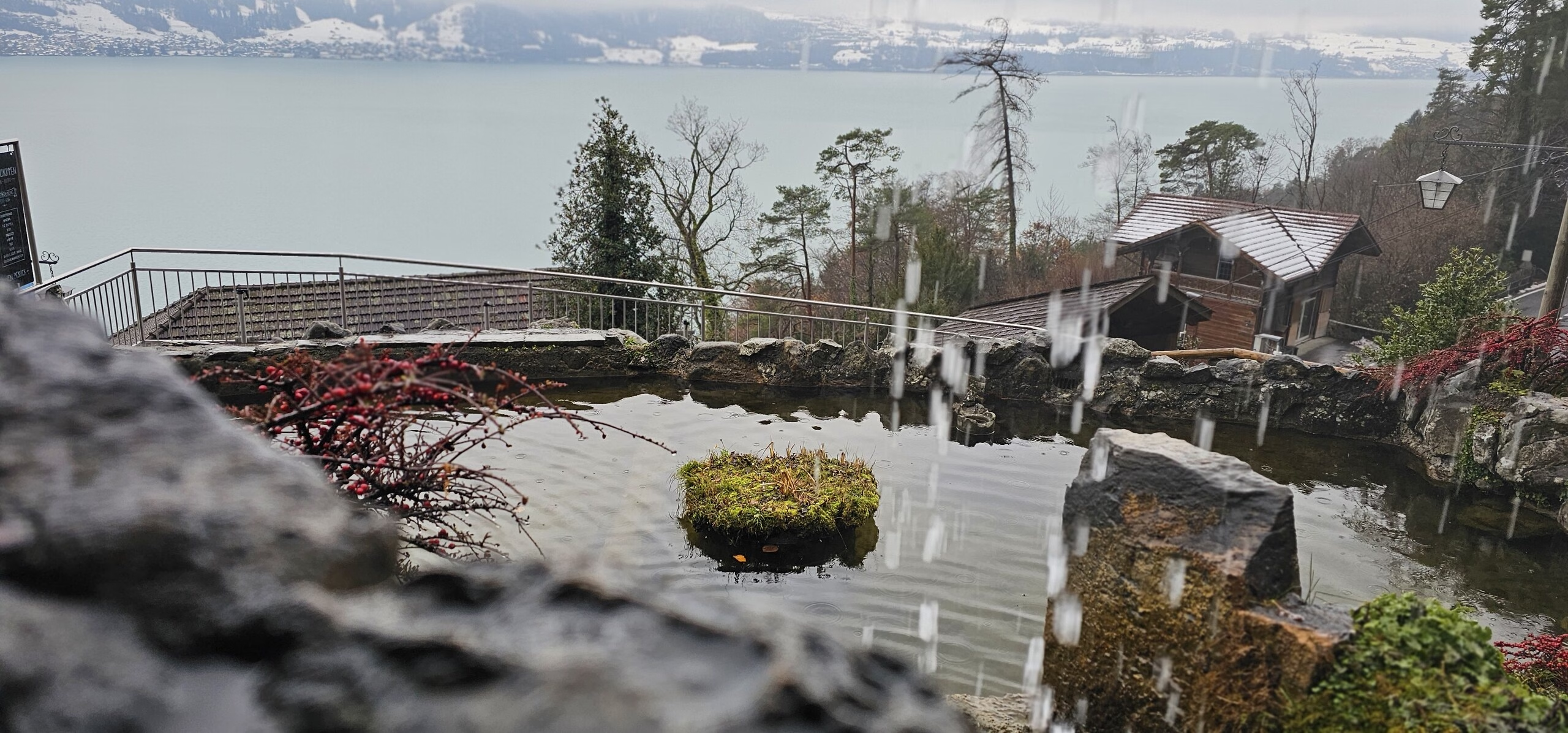
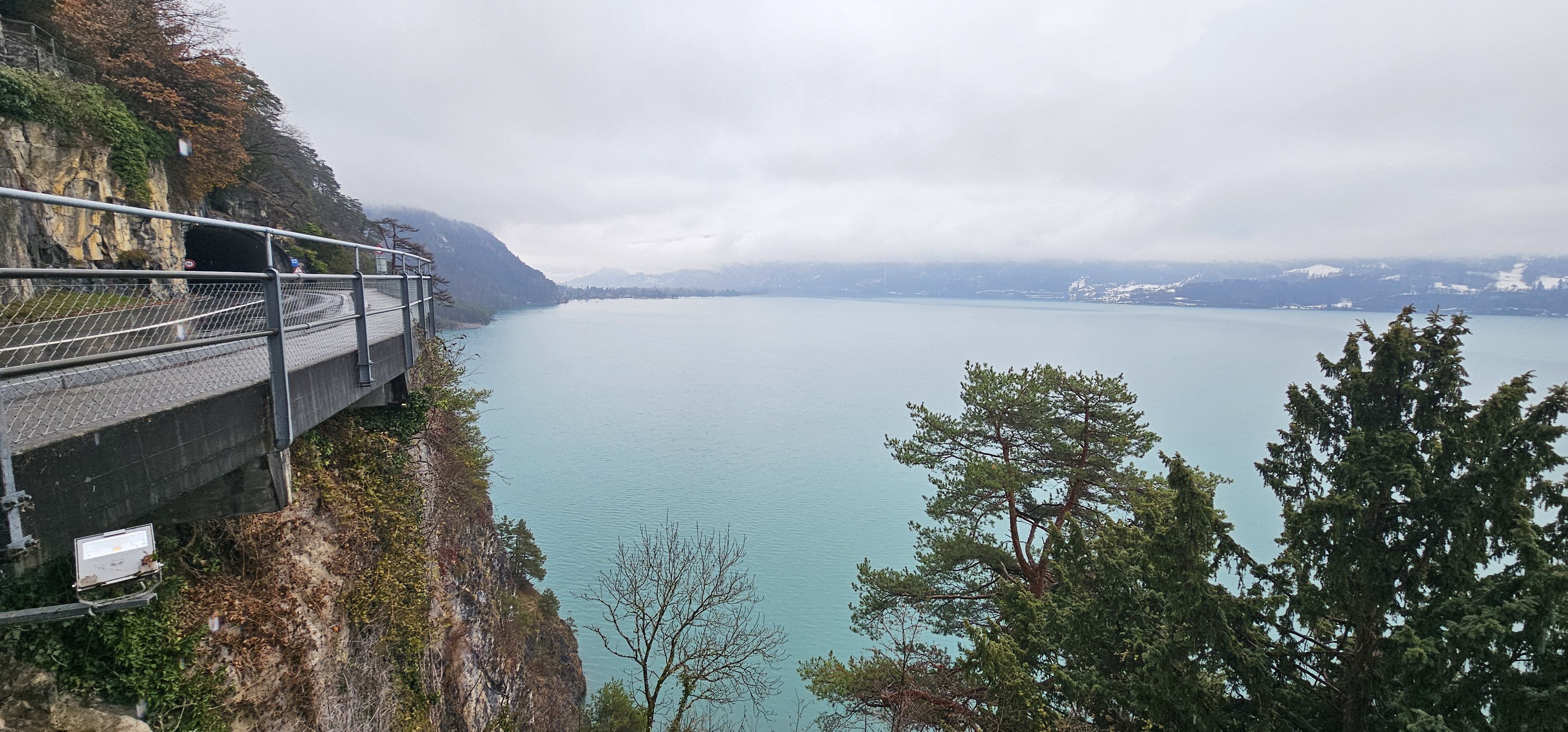
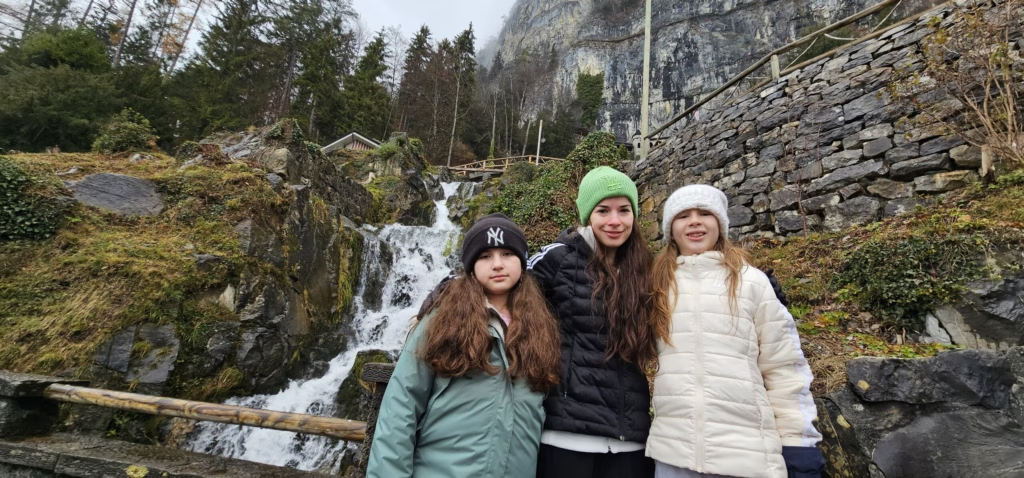
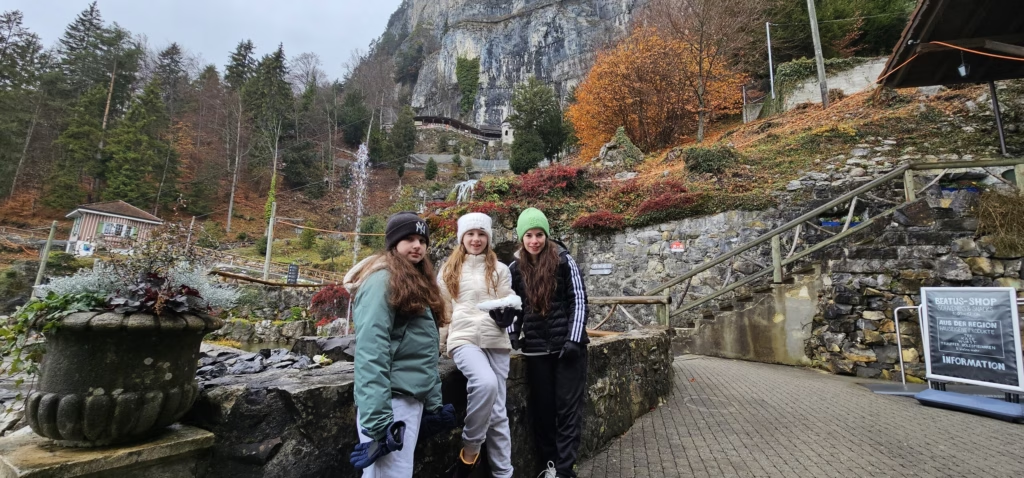
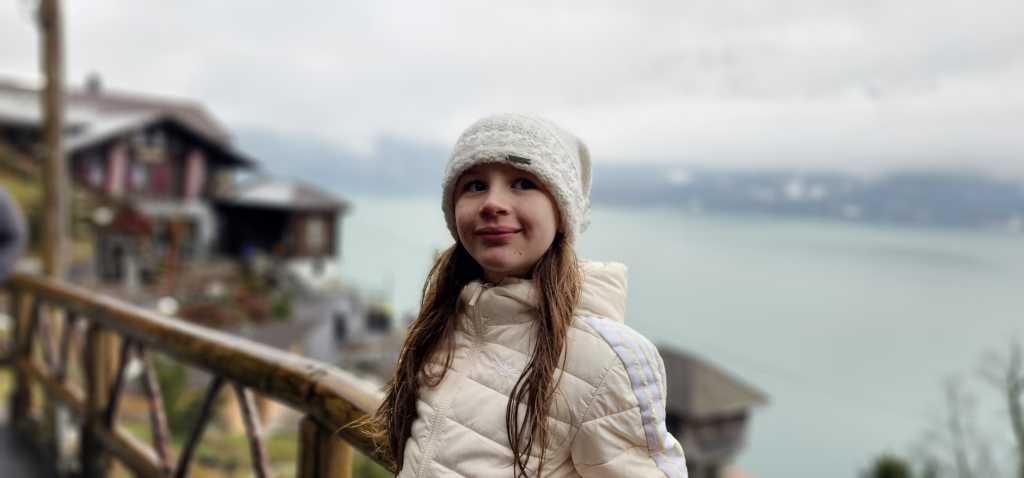
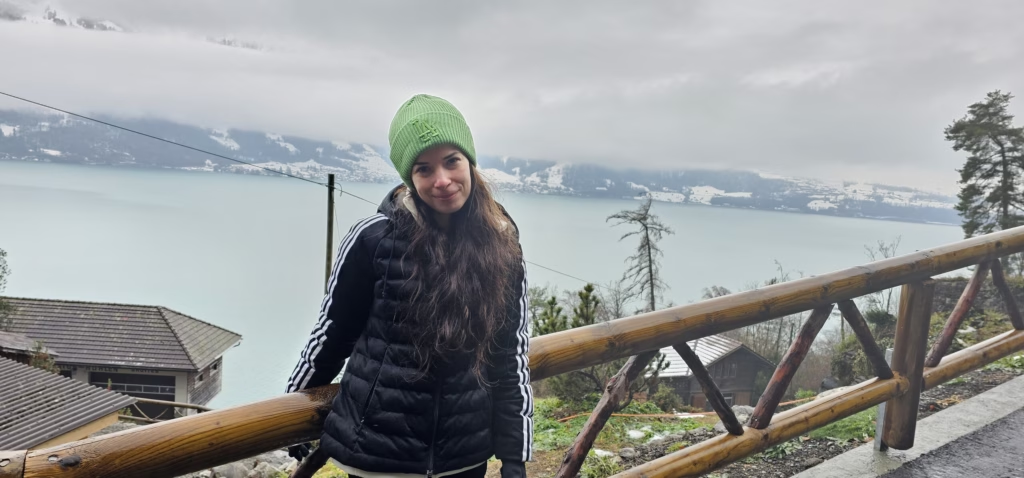
The approach path from the lower car park runs about ten minutes along the cliff base. It crosses the Beatus waterfall on a series of footbridges and arrives at a stone-arched viewpoint area in front of the cave entrance. The waterfall, fed by the underground cave stream, runs at its loudest in the wet months – that part of the operator’s pitch about a winter visit is honest, and a closed cave doesn’t close the falls.[1] The terrace railings above the approach look straight out across the lake to the Niesen massif on the south shore.
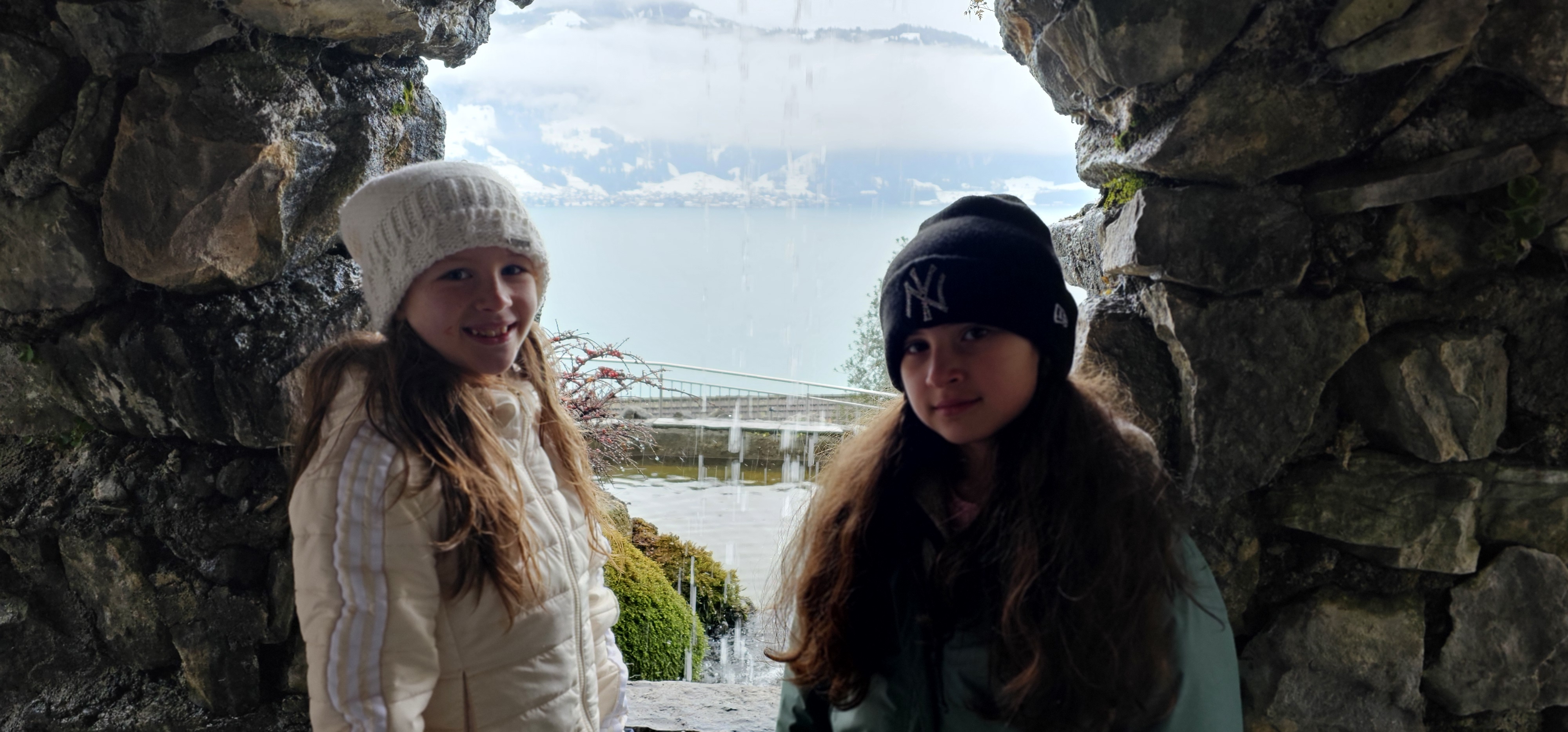
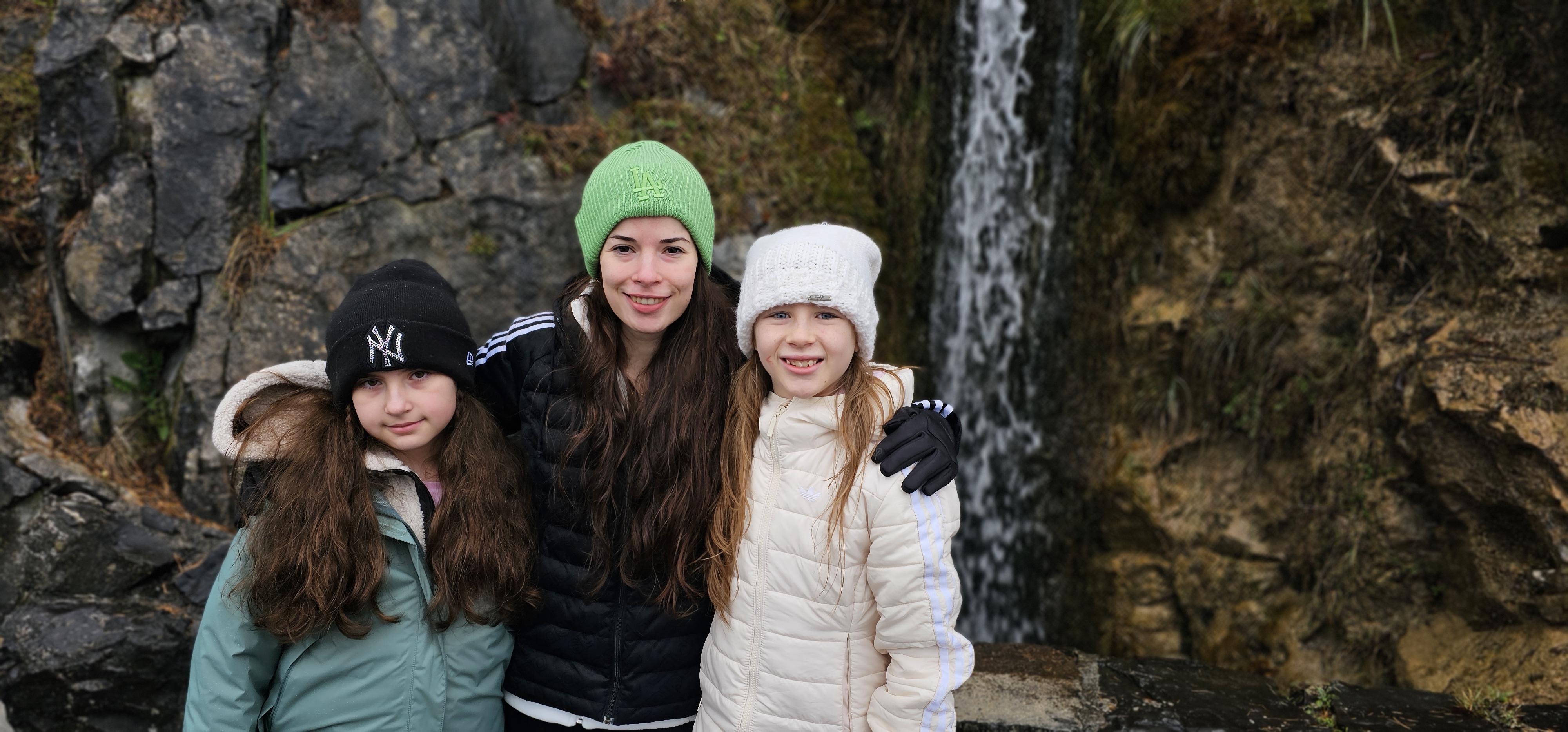
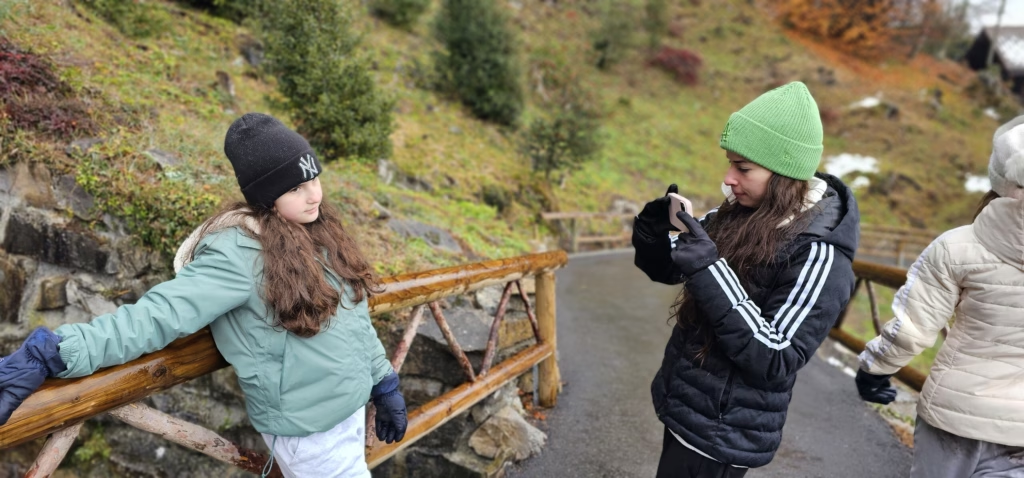
What we did once we realised the cave itself was locked: stood at the waterfall and took family photos, walked the wooden rail walkway around the terrace, framed shots through the stone arches looking out at the lake. The girls treated it as a winter playground without a name, which is exactly what it is when the cave is closed. We were back at the car in under an hour.
What the cave tour gives you when it’s open
The cave tour
I want to be clear about the boundary here: the description below is research, not lived experience – we never made it past the entrance. The illuminated route through the cave is about 1 km long and takes around 60 minutes at a walking pace, with 297 steps and 87 m of elevation gain inside the mountain.[1] The path is signposted in German and English, with information boards on geology and history along the way; the operator’s app guide adds French.[2]
Inside, the cave holds 8–10 °C and around 95% humidity, which keeps the steps and handrails damp.[2] A warm mid-layer is recommended in any season; in winter the layers you arrived in will carry you through. The cave route is not pushchair- or wheelchair-accessible. With a stroller-age child, plan for one parent to take the cave tour while the other stays with the museum and the playground area, both of which are barrier-free.[2]
Photography is allowed; tripods stay at the cash desk so they do not block foot traffic.[2] The operator notes that the cave tour is particularly worthwhile in rainy weather, when the entrance waterfall is at its most spectacular – and the waterfall is the part you get even when the cave is locked.[1]
Flimbo Trail and the park area
The Flimbo Trail (Flimboweg) is the operator’s interactive adventure trail through the outdoor park, designed for families with younger children. It runs from the museum out through the forest with puzzle stations and fire pits along the way, and takes about 1 to 1.5 hours.[2] There is a playground with a dragon slide and a children’s menu at the restaurant.
The Flimbo trailhead was not accessible the morning we visited, so the trail itself is a research write-up here rather than a lived recommendation. In summer, with sun on the restaurant terrace and the museum open, it is the natural next step after the tour.
The cave museum
The cave museum sits next to the upper car park and is included in the cave admission. It can also be visited on its own (adults CHF 6, children 6–16 CHF 3).[2] The trilingual app guide is part of the museum entry. As of May 2026 winter museum hours are daily 12:00–17:30.[2] It is a 30-minute add-on at the end of the cave tour, and it is barrier-free for any member of the group who skipped the steps.
Where to eat: Stein & Sein restaurant
The Stein & Sein restaurant on site has a terrace with a panoramic view of Lake Thun and the Bernese Alps, and is open through the year alongside the cave. As of May 2026 winter restaurant hours are Mon–Fri 10:00–17:00, Sat 10:00–21:00, Sun 09:30–17:00. The summer schedule extends Friday and Saturday service until 22:00.[2]
There is a children’s menu, and the restaurant is the natural lunch stop after the cave tour: cave tour ends around the museum / upper car park, restaurant is a few steps from there. Eating, drinking, and smoking are not permitted in the cave for cave-protection reasons, so the restaurant or the terrace are the only options on site if you arrive hungry.[2] The terrace was not staffed the morning we visited, so this is a research note rather than a lived recommendation; on a clear day in any season the lake view is the obvious draw.
Practical tips
- Phone before you drive up: off-season renovation closures are not always announced on the operator’s homepage. The St. Beatus Caves Lake Thun entrance was locked on our December 2023 visit despite the published winter hours suggesting otherwise. A 30-second phone call to the operator before you leave Interlaken or Thun would have saved us the climb.
- Drive from KMC: roughly 6 hours via A6, Alsace, and the Swiss A2 to Interlaken. The Swiss vignette (CHF 40) is mandatory; buy it online before crossing or at any border-area gas station.
- Public transport: the “Beatushöhlen” bus stop (STI line) is right at the entrance, with regular service from Thun and Interlaken. The BLS Lake Thun ferry stops at “Beatushöhlen-Sundlauenen” at the lakeshore, with a 20–25 minute uphill walk to the cave; the BLS combined boat + cave ticket gets you 50% off cave admission.[2]
- Footwear and layers: the cave is 8–10 °C and 95% humidity with damp steps, and the cliff-side approach path gets slick in wet weather. Hiking shoes or sturdy soles, a warm mid-layer, a rain shell, and a hat. The cave temperature does not change with the season, so in summer you over-layer for the cave and peel back on the terrace; in winter you wear what you arrived in.
- Photography: allowed inside, no tripods (leave at the cash desk). Phones are encouraged. A tripodless smartphone shot of interior stalactites tends to come out as a smear; the exterior waterfall and the cliff-path approach are the strongest photo positions, and those are available whether or not the cave is open.
- Family ticket math: at CHF 52 for two adults + own children 6–16, the family ticket beats individual admissions for any family with two or more children.
- Best time of day: the cave is illuminated indoors, so time-of-day matters less than for outdoor sights. For the lake-view approach path, mid-morning to early afternoon is the strongest light, especially in winter when the sun rides low. Last admissions in winter are 16:15 (Sun–Fri) or 17:45 (Sat); a 13:00 arrival gives you the cave, the museum, and a long lunch without rushing.[2]
- Cash and cards: Swiss-franc cash is useful for parking machines; cards work at the cash desk and the restaurant. If you pay in euros, the smaller automated machines may not dispense euro change.
From the visit
Sources
- Beatus-Höhlen-Genossenschaft, Cave Experience Detail, beatushoehlen.swiss (retrieved 2026-05-22).
- Beatus-Höhlen-Genossenschaft, Opening Hours, Prices, Arrival (Info Centre), beatushoehlen.swiss/en/info-centre (retrieved 2026-05-22).
- Wikipedia (English), Beatus of Lungern, en.wikipedia.org (retrieved 2026-05-22).
- Wikipedia (Deutsch), St. Beatus-Höhlen, de.wikipedia.org (retrieved 2026-05-22).
- Wikipedia (Deutsch), Beatenberg, de.wikipedia.org (retrieved 2026-05-22).