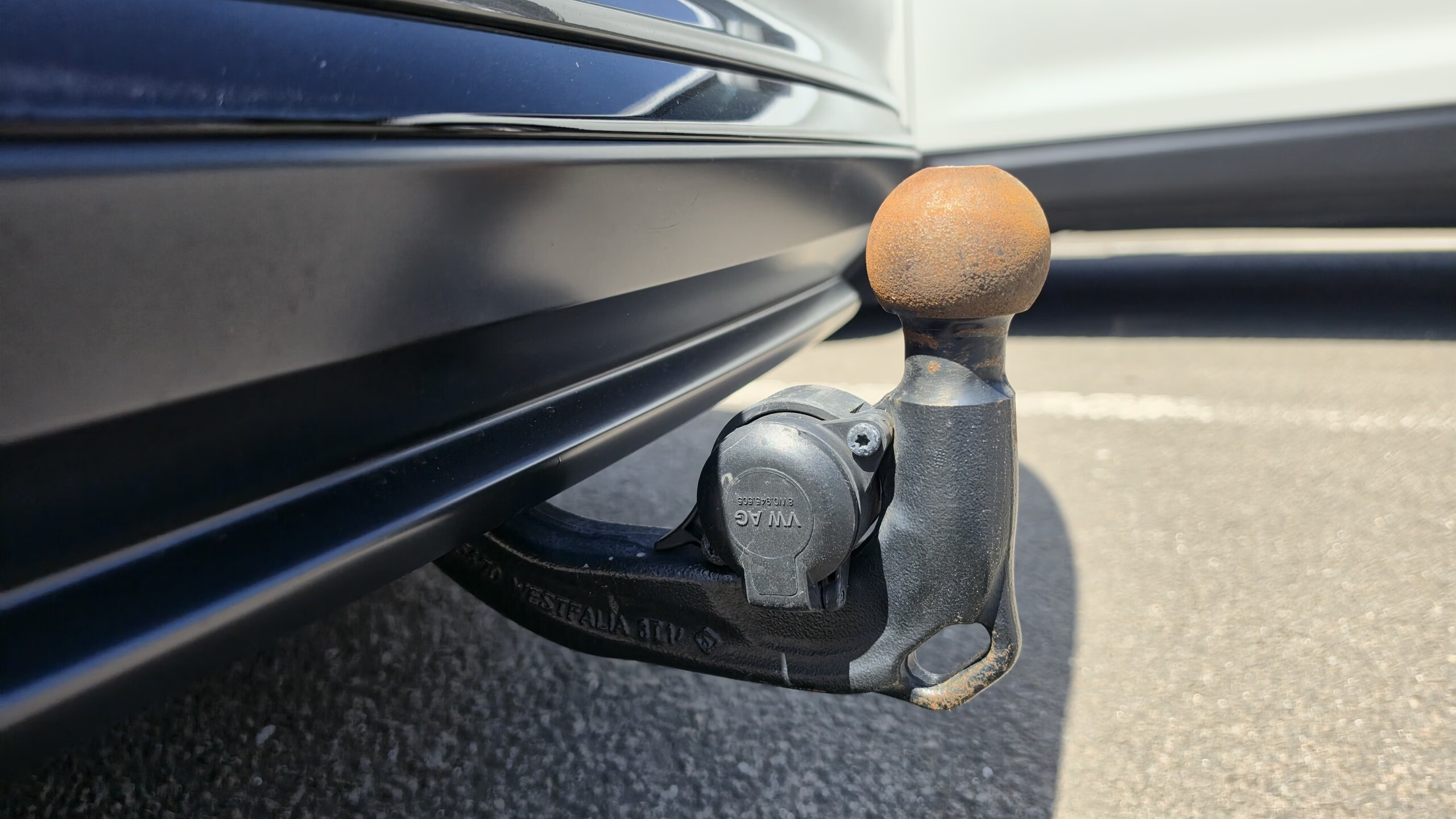

As of April 2026: if you live in Germany and your name is on a German civilian vehicle registration (Zulassungsbescheinigung Teil I, the vehicle registration certificate), you owe Kfz-Steuer (Kraftfahrzeugsteuer, the German motor-vehicle tax) every year. The bill is set by a federal formula in the Kraftfahrzeugsteuergesetz (KraftStG, the motor-vehicle tax act): the assessment lives in KraftStG § 8, and the rates that feed it are in KraftStG § 9. For a large-displacement V8 truck, the formula produces a number that surprises people the first time they see it.[1]
Below: the math as the Bundesministerium der Finanzen (the federal finance ministry) and the Hauptzollamt (the regional customs office that administers Kfz-Steuer) actually compute it, three worked examples on common US trucks (Ford F-150, Chevrolet Tahoe, Toyota Tundra), and the SOFA-versus-customs-document question that the American forums in Kaiserslautern get wrong almost every time.
The audience here is Kaiserslautern Military Community (KMC) residents (active duty, GS, TESA-accredited contractors, and US military retirees) who are looking at a German civilian Zulassung for a US-spec vehicle, plus Americans buying a European-spec car locally who want to predict the tax bill before signing. I went through the personal-status SOFA-to-civilian transition myself in January 2025 [primary-source: retirement effective January 2025]; my own civilian car is EU-spec, so the worked examples below come from the BMF Kfz-Steuer-Rechner math against KMC-retiree patterns I have witnessed, not from a US-spec Kfz-Steuerbescheid of my own. Your local Finanzamt and the Hauptzollamt that administers Kfz-Steuer are the binding voices on your specific case.
Regulations vary by US state and German Bundesland. This post reflects one American family’s lived experience with the procedure described, sourced against current German federal regulation as cited. Specific outcomes depend on the US state your title or license was issued in, the German Bundesland where you register, and the office processing your case. Verify directly with the responsible Bundesland authority (Führerscheinstelle, Zulassungsstelle, Zollamt as applicable) before acting on anything here.

What Kraftfahrzeugsteuer Is and Who Pays It
As of April 2026: Kfz-Steuer is a federal tax on holding a vehicle that is registered in Germany. Since 1 July 2014 it has been administered by the Bundeszollverwaltung (the federal customs administration) through the regional Hauptzollamt offices, not by the Land or municipal authorities; before that date it was a Land tax collected by the Finanzamt (the regional tax office).
The tax is owed by the Halter (the registered keeper), it accrues for as long as the vehicle is registered, and it is collected by direct debit from a German bank account.[1]
The Halter pays it. That distinction matters in the KMC because for years many Americans drove vehicles that were not registered in the German civilian system at all. They were on USAREUR Forces plates (the green plates), administered by the US military Vehicle Registration office on installations like Ramstein and Vogelweh. A Forces-plate vehicle is exempt from Kfz-Steuer under KraftStG § 3 Nr. 2, which exempts vehicles used exclusively in the service of the Bundeswehr, Bundespolizei, Polizei, or Zollverwaltung (solange sie ausschließlich im Dienst) and is extended by treaty to NATO Forces vehicles in active service.[2]
Once the same vehicle moves to a German civilian Zulassung (a normal black-on-white plate from the Zulassungsstelle in Kaiserslautern, Landstuhl, or wherever you live), the KraftStG § 3 Nr. 2 exemption ends and the full KraftStG § 8 and § 9 formula starts running. That transition is what almost every US-truck Kfz-Steuer question in this region is really about.
Pkw vs. Lkw: The Classification That Changes the Formula
As of April 2026: before the KraftStG § 8 assessment even applies, the vehicle has to be classified. KraftStG § 8 routes Kfz-Steuer through one of two main tracks based on what the Zulassungsstelle (the vehicle registration office) wrote in the Fahrzeugklasse (vehicle class) field of the Zulassungsbescheinigung Teil I. A passenger car (Pkw, EU class M1, “Personenkraftwagen”) with a zulässige Gesamtmasse (permissible gross vehicle weight) up to 3,500 kg falls under the Hubraum-plus-CO2 formula in KraftStG § 8 Nr. 1. A truck (Lkw, EU class N) over 3,500 kg falls under the weight-based tariff in KraftStG § 8 Nr. 2, and any Lkw at or below 3,500 kg gets a different per-200-kg weight tariff.[3]
Most US full-size pickups straddle this line. A Ford F-150 SuperCrew with a payload package can be specified at exactly 3,500 kg zulässige Gesamtmasse to stay in Pkw territory; a Ford F-250 or a Ram 2500 at 4,500 kg or more is firmly Lkw. Some owners try to force an Lkw classification on a half-ton pickup hoping for the lower weight-based tariff, but the FZV (Fahrzeug-Zulassungsverordnung, the vehicle registration ordinance) and StVZO (Straßenverkehrs-Zulassungs-Ordnung, the road-traffic licensing regulation) criteria are technical and physical: an Lkw needs a fixed bed wall separating cab from cargo, the load area must exceed the seating area.
The rear seats are typically removed or fitted with a partition, and the maximum permitted seating count drops. Reclassification is rarely worth the loss of utility for a daily-driver pickup, and the Hauptzollamt rejects classifications that do not match the physical configuration.
This post covers the Pkw track only. Lkw over 3.5 t, motorhomes, motorcycles, and commercial vehicles use separate KraftStG formulas that are out of scope here.
The KraftStG § 8 Formula: Hubraum Plus Kohlendioxidemission
As of April 2026: for a Pkw first registered on or after 1 January 2021, the annual Kfz-Steuer is the sum of two components defined in Kraftfahrzeugsteuergesetz (KraftStG) § 8 Nr. 1 and computed by the rates in KraftStG § 9 Abs. 1 Nr. 2 lit. c.[4]
- Hubraum-Sockelbetrag (displacement base charge): €2.00 per started 100 cm³ for a gasoline engine (Otto / Fremdzündung, spark-ignition), €9.50 per started 100 cm³ for diesel (Selbstzündung, compression-ignition). “Per started 100 cm³” (
angefangene 100 Kubikzentimeter Hubraum) means rounded up: a 5,038 cm³ engine counts as 51 chunks of 100 cm³, not 50.38. - Emissionsbetrag (CO2 emissions charge): the first 95 g/km of Kohlendioxidemission (CO2 output) are free. The grams above 95 are split into six staircase tiers, each charged at a different rate per gram: €2.00, €2.20, €2.50, €2.90, €3.40, and €4.00 per gram.
The Kraftstoffart (fuel type: Otto vs. Selbstzündung) and the Kohlendioxidemission set out in KraftStG § 9 Abs. 1 Nr. 2 lit. c are the two values the Hauptzollamt reads off your Zulassungsbescheinigung Teil I. The CO2 staircase looks like this:
| CO2 band (g/km) | Rate per gram in band |
|---|---|
| over 95 up to 115 | €2.00 |
| over 115 up to 135 | €2.20 |
| over 135 up to 155 | €2.50 |
| over 155 up to 175 | €2.90 |
| over 175 up to 195 | €3.40 |
| over 195 | €4.00 |
The CO2 figure that matters is the WLTP value in field V.7 of your Zulassungsbescheinigung Teil I, not the EPA combined number on the Monroney sticker that came with the truck from the US dealership.[5] WLTP (Worldwide harmonised Light vehicles Test Procedure) is the European homologation cycle introduced in 2018, and it tends to produce higher CO2 numbers than the older NEFZ cycle. The same model registered in 2020 and in 2018 can therefore carry different tax bills.[6]
Why US Trucks Hit the Top of the Staircase
Two design choices in KraftStG § 9 work against US-spec trucks. First, the Hubraum component is per started 100 cm³ with no ceiling. A 5.7-liter V8 pays roughly twice the displacement bill of a 2.0-liter European turbo before the CO2 component is even added. Second, the CO2 staircase has a top band of “over 195 g/km” charged at €4.00 per gram with no upper bound. The marginal cost of every gram of Kohlendioxidemission a US V8 emits above 195 is €4 per year per gram, indefinitely.
For a typical US full-size truck on a long-block V8, the WLTP CO2 figure comes in somewhere between 240 and 300 g/km. Every one of those grams above 195 is in the €4 band. That single fact is responsible for most of the sticker shock.
For a typical US full-size truck on a long-block V8, the WLTP CO2 figure comes in somewhere between 240 and 300 g/km. Every one of those grams above 195 is in the €4 band.
Worked Examples: F-150, Tahoe, Tundra
As of April 2026, here is what the KraftStG § 8 and § 9 formula produces for three common US trucks, computed by hand and matching what the Bundesministerium der Finanzen Kfz-Steuer-Rechner returns for the same inputs.[5] I am assuming first registration in 2021 or later (so the post-2021 staircase applies), gasoline (Otto) motor, and a sample CO2 figure roughly representative of WLTP figures published in EU type-approval data for that model. Your specific vehicle’s V.7 number will set the actual bill, so always pull it from the Zulassungsbescheinigung Teil I.
Ford F-150 5.0L V8 (5,038 cm³, ~250 g/km CO2)
- Hubraum: 5,038 cm³ rounds up to 51 × 100 cm³ chunks. 51 × €2.00 = €102.00.
- CO2 staircase, 250 g/km minus 95 g/km free = 155 chargeable grams:
- 95 to 115: 20 g × €2.00 = €40.00
- 115 to 135: 20 g × €2.20 = €44.00
- 135 to 155: 20 g × €2.50 = €50.00
- 155 to 175: 20 g × €2.90 = €58.00
- 175 to 195: 20 g × €3.40 = €68.00
- 195 to 250: 55 g × €4.00 = €220.00
- CO2 subtotal: €480.00
- Annual Kfz-Steuer: €102.00 + €480.00 = €582.00
Chevrolet Tahoe 5.3L V8 (5,328 cm³, ~270 g/km CO2)
- Hubraum: 5,328 cm³ rounds up to 54 × 100 cm³ chunks. 54 × €2.00 = €108.00.
- CO2 staircase, 270 g/km minus 95 g/km free = 175 chargeable grams:
- 95 to 195 (full bands 1 to 5): €40 + €44 + €50 + €58 + €68 = €260.00
- 195 to 270: 75 g × €4.00 = €300.00
- CO2 subtotal: €560.00
- Annual Kfz-Steuer: €108.00 + €560.00 = €668.00
Toyota Tundra 5.7L V8 (5,663 cm³, ~290 g/km CO2)
- Hubraum: 5,663 cm³ rounds up to 57 × 100 cm³ chunks. 57 × €2.00 = €114.00.
- CO2 staircase, 290 g/km minus 95 g/km free = 195 chargeable grams:
- 95 to 195 (full bands 1 to 5): €260.00
- 195 to 290: 95 g × €4.00 = €380.00
- CO2 subtotal: €640.00
- Annual Kfz-Steuer: €114.00 + €640.00 = €754.00
| Vehicle | Hubraum | CO2 g/km | Annual Kfz-Steuer |
|---|---|---|---|
| Ford F-150 5.0L V8 | 5,038 cm³ | ~250 | €582 |
| Chevrolet Tahoe 5.3L V8 | 5,328 cm³ | ~270 | €668 |
| Toyota Tundra 5.7L V8 | 5,663 cm³ | ~290 | €754 |
Two takeaways. First, the Hubraum component for these three trucks is small (around €100 per year). The Emissionsbetrag is what does the damage, and it scales nearly linearly above 195 g/km because every additional gram is in the €4 band. Second, a difference of 40 g/km between the F-150 and the Tundra translates to roughly €170 per year in tax forever, which is why the WLTP figure on your Zulassungsbescheinigung Teil I matters more than any other number on the document.
For vehicles first registered before 1 January 2021 the older staircase applies (a flat €2.00 per gram CO2 above 95 g/km for first registrations from 1 January 2014 onward, with no progressive bands), which produces a meaningfully smaller CO2 bill on the same engine.[7] Pre-July-2009 vehicles use a different formula again under KraftStG § 8 Nr. 1 lit. a, with the rates in § 9 Abs. 1 Nr. 2 lit. a: per-100-cm³ rates set by emissions class, with no per-gram CO2 charge. The § 18 transition rules (especially Abs. 4, 4a and 12) pin the formula to the vehicle’s original first-registration date.
SOFA Article 67 Kfz-Steuer-Befreiung Versus the Retiree Reality
As of April 2026: American forums get this part wrong almost every time. What people call “SOFA Article 67” is Article 67 of the NATO Truppenstatut Zusatzabkommen (NATO-ZA, the supplementary agreement to the NATO Status of Forces Agreement), and it covers Umsatzsteuer (VAT) on procurement by the stationed forces, not Kraftfahrzeugsteuer. The Bundesministerium der Finanzen Umsatzsteuer-Handbuch Anhang 6 frames Article 67 as a procurement-VAT instrument supporting the common defense, exempting the sending states’ procurement expenditures for their stationed forces from German VAT.[8] Article 67 is a procurement-VAT instrument. It is not a Kfz-Steuer rule.
Kfz-Steuer for a Forces-plate vehicle is exempt for a different reason: Kraftfahrzeugsteuergesetz (KraftStG) § 3 Nr. 2 (vehicles in active service of the Forces, treaty-extended to NATO troops) for vehicles operated under the US military registration system, and KraftStG § 3 Nr. 13 for foreign-plate POVs that are temporarily in Germany. KraftStG § 3 Nr. 13 specifically exempts foreign passenger vehicles and their trailers brought into Germany for a temporary stay (zum vorübergehenden Aufenthalt) for up to one year, with one critical clause: the exemption falls away if the vehicles are used for commercial transport of persons or goods, or if a regular base of operation in Germany (regelmäßiger Standort im Inland) has been established.[2]
Regelmäßiger Standort im Inland is the trigger. The Zoll’s plain-language explainer is unambiguous: when a household moves from abroad to Germany and brings a vehicle along, that vehicle establishes a regular base of operation in Germany at that moment.[9] The moment the vehicle has a permanent home in Germany, the exemption is gone and the FZV registration requirement applies.
Where the TrZollV § 17 Bescheinigung (Pink Card) Fits
A US military retiree in Germany holding a TrZollV § 17 Bescheinigung (Pink Card) does not have SOFA status. SOFA status is for active-duty service members, US-government civilian employees, and TESA-accredited contractors.
The TrZollV § 17 Bescheinigung grants a customs procedure for on-installation purchases under the Truppenzollverordnung (the forces customs ordinance); installation gate access is granted separately by the DoD Retiree ID (DEERS-issued). The Bescheinigung is a separate physical document from the DoD Retiree ID, and neither one extends the KraftStG § 3 Nr. 2 exemption to the holder’s privately-owned vehicle. A retiree’s POV cannot be on USAREUR Forces plates.
AER 550-175 § 21(a)(2) requires POVs to come off USAREUR plates at retirement; the vehicle must be on German civilian plates, and it pays the full KraftStG § 8 and § 9 formula like any other Kfz registered in Germany.[10] I cover what the Bescheinigung actually does, and what it does not do, in TrZollV § 17 Bescheinigung (Pink Card): What This Retiree Customs Card Actually Gets You.
I went through this personal-status transition myself. I retired from active duty in January 2025 [primary-source: retirement effective January 2025]. The day my SOFA status ended was the day my eligibility for USAREUR Forces plates ended. The vehicle side of that picture did not apply to me personally because my civilian car is EU-spec, but the Forces-to-civilian Zulassung pathway is the same one any KMC retiree in this position takes for a US-spec vehicle, and the Kfz-Steuerbescheide that follow from the Hauptzollamt are what the worked examples below are calibrated against.
The Statuswechsel: From USAREUR Plates to Civilian Zulassung
As of April 2026: the Statuswechsel (status-change process) of moving a vehicle from the US military registration system to the German civilian system is a multi-step process, and Kfz-Steuer is the consequence at the end of it, not the gating step. The sequence in our region (Kaiserslautern / Ramstein / Vogelweh) typically runs:
- De-register from USAREUR Vehicle Registration. Turn in the USAREUR plates and the AE Form 190-1A registration document at the Vehicle Registration office on installation.
- Obtain a German Hauptuntersuchung (HU / TÜV, the periodic technical inspection) and an Abgasuntersuchung (AU, the emissions check) at TÜV Süd, TÜV Rheinland, or DEKRA. A US-spec vehicle will need a Vollabnahme (full type-approval inspection) under § 21 StVZO unless it is one of the rare US models with an EU certificate of conformity. Expect the Vollabnahme to flag headlight beam pattern, front side-marker lights, rear fog lamp, and speedometer kph display; some of these will need to be modified before TÜV will pass the vehicle. If you tow, the inspection also checks the hitch and its rating, which I work through in US Class I-V vs German ECE-R55: Practical Hitch Ratings Guide.
- Buy German vehicle insurance (Kfz-Haftpflicht, the mandatory third-party liability cover) and obtain the eVB-Nummer (electronic insurance confirmation number) from the insurer. Without an eVB-Nummer the Zulassungsstelle will not register the vehicle.
- Register at the local Zulassungsstelle (Kaiserslautern, Landstuhl, Pirmasens, depending on Kreis). Bring the TÜV/AU certificate, eVB-Nummer, proof of ownership, your Aufenthaltstitel (residence permit) or German ID, and a SEPA mandate for the Kfz-Steuer direct debit. They issue the Zulassungsbescheinigung Teil I and Teil II (the registration certificate, parts 1 and 2), the German license plates, and the data is forwarded to the Hauptzollamt that administers Kfz-Steuer in your area.
- Wait for the Kfz-Steuerbescheid (the tax assessment notice), which arrives by post from the Hauptzollamt and locks in the annual amount. The first debit follows shortly after.
The Kfz-Steuer-Pflicht (the tax liability period) starts the day the vehicle is registered in the German civilian system, which is the day the regelmäßiger Standort im Inland is formally established for tax purposes.[11] The pre-registration period under USAREUR Forces plates does not retroactively trigger Kfz-Steuer.
How to Predict the Bill Before You Register
As of April 2026: the cleanest way to predict your Kfz-Steuer is to feed the actual figures from your Zulassungsbescheinigung Teil I (or the EU certificate of conformity for an unregistered vehicle) into the Bundesministerium der Finanzen Kfz-Steuer-Rechner (the online motor-vehicle tax calculator).[5] You need four inputs: Fahrzeugart (vehicle type: Pkw), Antriebsart (drive type: Otto / Diesel), Hubraum in cm³, and Kohlendioxidemission in g/km. The output matches what the Hauptzollamt assesses.
If you do not yet have the WLTP CO2 figure in hand, EU type-approval data for the model and engine is publicly searchable. Be careful: EPA and WLTP are different test cycles and not interchangeable. An EPA-label-derived CO2 estimate typically lands near, and often somewhat above, the eventual WLTP figure, because the EPA label is adjusted toward real-world driving. Treat an EPA-derived number as a rough ceiling, not the bill: only the WLTP value in field V.7 of the Zulassungsbescheinigung is binding for the tax.
Three honest options to lower the assessment:
- Sell the US-spec V8 before the Statuswechsel and buy a smaller European-spec vehicle locally. A 2.0-liter Otto turbo at 150 g/km comes out around €150 per year in total. The math I just walked through is why most retirees in our community do not bring the F-250 home.
- Verify which CO2 cycle is on your COC. Vehicles homologated under NEFZ (pre-September 2018 in most cases) have lower CO2 figures than the same vehicle re-homologated under WLTP. The number on your Zulassungsbescheinigung Teil I is the binding number; check field V.7 carefully.
- Consider a pure electric vehicle. Reine Elektrofahrzeuge first registered between 18 May 2011 and 31 December 2030 are exempt from Kfz-Steuer for ten years from the registration date, with the exemption ending no later than 31 December 2035, under KraftStG § 3d.[12] Once the KraftStG § 3d window ends, an electric Pkw falls back to a 50 percent reduction of the otherwise-applicable rate under KraftStG § 9 Abs. 2.[13]
Common Misconceptions vs. What the Regulations Actually Say
The conversations I have had in the KMC about US trucks and German Kfz-Steuer repeat the same mistaken framings. Each entry below is something I have personally heard, paired with what KraftStG § 3, § 8, and § 9 and AER 550-175 actually say.
-
“My truck pays cheap European Kfz-Steuer because it’s a truck.”Most US half-ton pickups (F-150, Ram 1500, Silverado, Tundra) are classified Pkw at or below 3,500 kg zulässige Gesamtmasse and pay under the KraftStG § 8 Nr. 1 Hubraum-plus-CO2 formula, not the lighter Lkw weight tariff. The Pkw formula on a V8 produces €580 to €750 per year; “European Kfz-Steuer” suggests a €100 to €200 number that does not exist for these vehicles.
-
“USAREUR plates make my Kfz-Steuer zero.”The exemption on USAREUR plates is KraftStG § 3 Nr. 2 (vehicles in active service of the Forces, treaty-extended to NATO troops). It applies only while the vehicle is in the USAREUR Vehicle Registration system. The day the vehicle is on a German civilian Zulassungsbescheinigung Teil I, the exemption is gone, regardless of who the Halter is.
-
“Retirees stay on USAREUR plates so retirees don’t pay Kfz-Steuer.”AER 550-175 § 21(a)(2) requires POVs to come off USAREUR plates at retirement. A retiree’s POV must be on German civilian plates and pays the full KraftStG § 8 and § 9 formula. Retirees do not have SOFA status; the Forces-plate eligibility ends with active duty.
-
“SOFA Article 67 covers my Kfz-Steuer.”Article 67 of the NATO-ZA Truppenstatut Zusatzabkommen covers Umsatzsteuer (VAT) on procurement by the stationed forces. It is not a Kfz-Steuer instrument. Kfz-Steuer exemptions are listed exhaustively in KraftStG § 3. There is no Article 67 Kfz-Steuer-Befreiung.
-
“The CO2 component is small. Only the Hubraum matters.”For modern V8 trucks the Emissionsbetrag dominates by a factor of four to six over the Hubraum-Sockelbetrag. On a Ford F-150 example, displacement contributes €102 and CO2 contributes €480. Every gram of Kohlendioxidemission above 195 g/km is in the €4-per-gram top band of KraftStG § 9 Abs. 1 Nr. 2 lit. c with no upper bound.
-
“If I import a 1990s truck I avoid the CO2 charge.”Pre-July-2009 first-registration vehicles use a different formula under KraftStG § 8 Nr. 1 lit. a, with the rates in § 9 Abs. 1 Nr. 2 lit. a: per-100-cm³ rates set by Schadstoffklasse (the emissions class), with no per-gram CO2 charge. The KraftStG § 18 transition rules (especially Abs. 4, 4a and 12) pin the formula to the vehicle’s original first-registration date. The bill is generally lower, but it is not zero, and a 1990s US truck typically falls into the higher Schadstoffklasse tiers because of weak emission standards.
-
“I can register my US pickup as Lkw for the lower tax.”Lkw classification under FZV / StVZO has technical requirements: a fixed bed wall separating cab from cargo, load area exceeding seating area, reduced rear seating count, and physical configuration matching commercial-vehicle norms. The Hauptzollamt rejects classifications that do not match the vehicle’s physical configuration. A daily-driver crew-cab pickup with rear seats almost never qualifies.
-
“Kfz-Steuer is paid to the Stadt or the Landratsamt.”Since 1 July 2014, Kraftfahrzeugsteuer is administered by the Bundeszollverwaltung through the regional Hauptzollamt offices. Before that date it was a Land tax collected by the Finanzamt; the change is one of the more common stale facts in older expat forum threads.
-
“The dealer’s EPA combined MPG converts to my CO2 figure.”The Hauptzollamt reads the WLTP value in field V.7 of the Zulassungsbescheinigung Teil I, not the EPA Monroney sticker. EPA and WLTP are different test cycles and not interchangeable. An EPA-label-derived CO2 estimate typically lands near, and often somewhat above, the eventual WLTP figure, because the EPA label is adjusted toward real-world driving. Treat an EPA-derived number as a rough ceiling, not the bill: only the V.7 value is binding for the tax.
-
“Pink Card holders get a Kfz-Steuer discount.”The TrZollV § 17 Bescheinigung (Pink Card) is a customs procedure document for on-installation purchases under the Truppenzollverordnung. It has no relationship to Kfz-Steuer, and it is a separate document from the DoD Retiree ID. A retiree’s privately-owned vehicle on German civilian plates pays the full KraftStG § 8 and § 9 formula whether or not the retiree holds a Bescheinigung.
Sources
- Bundeszollverwaltung, Steuerhöhe (Kraftfahrzeugsteuer), zoll.de/DE/Privatpersonen/Kraftfahrzeugsteuer/Steuerhoehe/steuerhoehe_node.html (retrieved 2026-04-29).
- Kraftfahrzeugsteuergesetz § 3, gesetze-im-internet.de/kraftstg/__3.html (retrieved 2026-05-14).
- Kraftfahrzeugsteuergesetz § 8, gesetze-im-internet.de/kraftstg/__8.html (retrieved 2026-04-29).
- Kraftfahrzeugsteuergesetz § 9 Abs. 1 Nr. 2 lit. c, gesetze-im-internet.de/kraftstg/__9.html (retrieved 2026-05-14).
- Bundesministerium der Finanzen, Kfz-Steuer-Rechner methodology, bundesfinanzministerium.de/Web/DE/Service/Apps_Rechner/KfzRechner/KfzSteuerrechner.htm (retrieved 2026-04-29).
- ADAC Kfz-Steuer-Rechner explainer, adac.de/rund-ums-fahrzeug/auto-kaufen-verkaufen/kfz-steuer/kfz-steuer-rechner/ (retrieved 2026-04-29).
- Kraftfahrzeugsteuergesetz § 9 Abs. 1 Nr. 2 lit. b, gesetze-im-internet.de/kraftstg/__9.html (retrieved 2026-05-14).
- Bundesministerium der Finanzen, Umsatzsteuer-Handbuch Anhang 6 (Art. 67 ZA-NTS), usth.bundesfinanzministerium.de/usth/2018-2019/C-Anhaenge/Anhang-06/inhalt.html (retrieved 2026-04-29).
- Bundeszollverwaltung, Ausländische Fahrzeuge, zoll.de/DE/Fachthemen/Steuern/Verkehrsteuern/Kraftfahrzeugsteuer/Steuerverguenstigungen/Auslaendische-Fahrzeuge/auslaendische-fahrzeuge_node.html (retrieved 2026-04-29).
- Army in Europe Regulation 550-175, aafes.com/Images/GermanyFuelRationCard/aef550-175.pdf (retrieved 2026-04-29).
- Bundeszollverwaltung, Beginn und Ende der Steuerpflicht, zoll.de/DE/Privatpersonen/Kraftfahrzeugsteuer/Beginn-und-Ende-der-Steuerpflicht/beginn-und-ende-der-steuerpflicht_node.html (retrieved 2026-04-29).
- Kraftfahrzeugsteuergesetz § 3d, gesetze-im-internet.de/kraftstg/__3d.html (retrieved 2026-04-29).
- Kraftfahrzeugsteuergesetz § 9 Abs. 2, gesetze-im-internet.de/kraftstg/__9.html (retrieved 2026-05-14).