
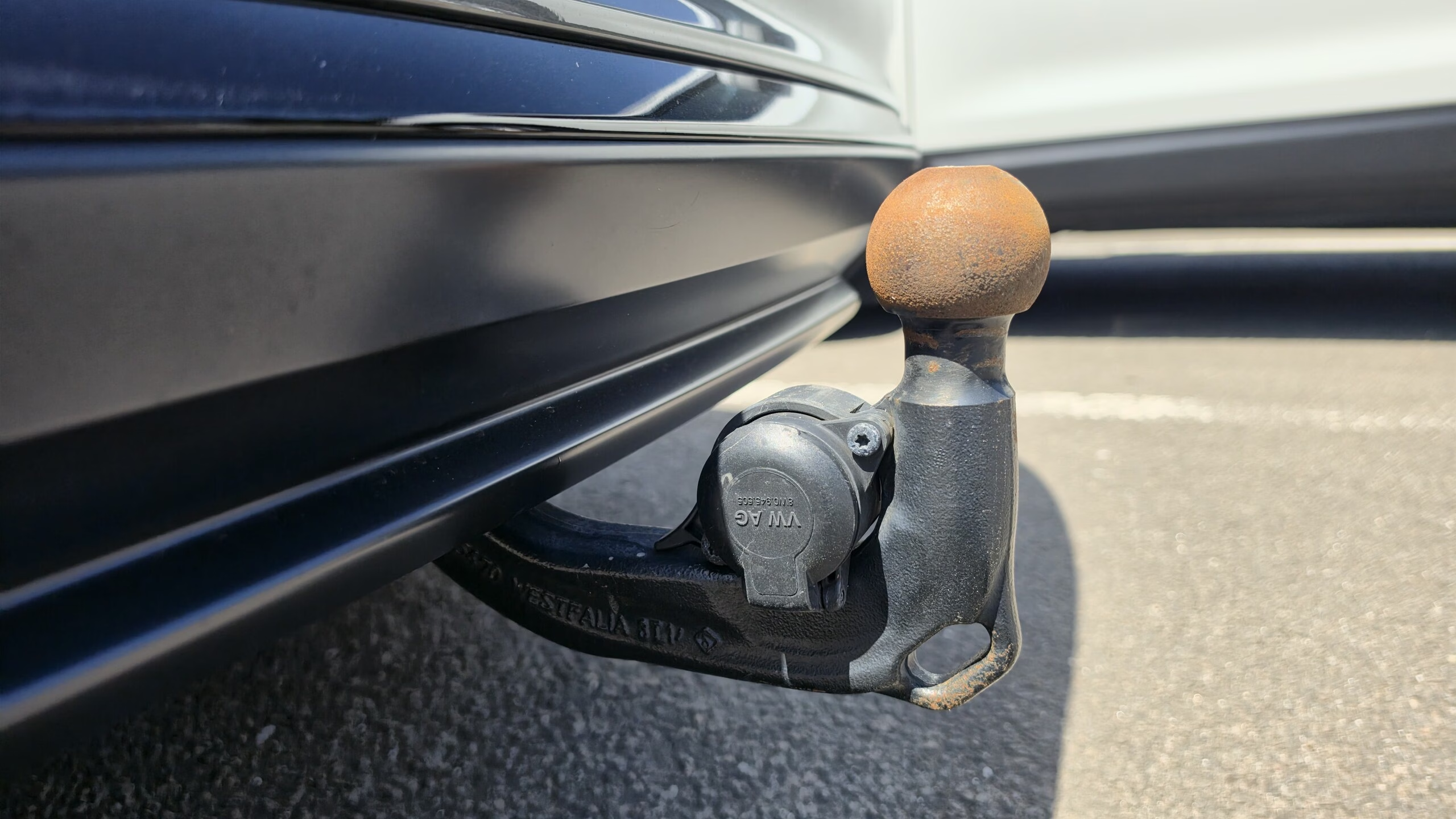
As of May 2026: the conversation about US hitch ratings ECE-R55 Germany at the KMC Stammtisch table runs in two languages and three different units, and the units do not match up the way people think they do. US Class I through V is one way to classify a receiver hitch. ECE-R55 (the United Nations Economic Commission for Europe Regulation No. 55, annexed to the 1958 Agreement on harmonized vehicle regulations) is a completely different classification using the D-value (in German, the D-Wert), measured in kilonewtons. The two are not interchangeable, and the German Zulassungsstelle (the vehicle registration office) does not care what your US hitch is rated for in pounds.
This post is for Americans living in the Kaiserslautern Military Community (KMC) who own or plan to buy a US-spec vehicle with a receiver-style hitch and want to tow legally on German plates. If you are a German national helping an American spouse work through this, the structure should still hold. If your vehicle is on USAREUR (US Army Europe) plates under the NATO Status of Forces Agreement (SOFA), some of what follows applies only after you transition off SOFA plates. I will flag those points explicitly. When I mention the Zulassungsstelle (the vehicle registration office), I mean the office that issues German civilian plates and enters vehicle data into the Zulassungsbescheinigung (the registration certificate).
I am not an engineer. The reading below is based on the published regulatory text, the ADAC (Allgemeiner Deutscher Automobil-Club) consumer guidance, and one Landkreis (the rural county around the city) Kaiserslautern Zulassungsstelle clerk’s verbal summary [primary-source: KMC-area conversations 2025, names omitted]. Anything specific to your vehicle gets confirmed by a TÜV (Technischer Überwachungsverein) or DEKRA prüfer (inspector), not by a blog post.
Regulations vary by US state and German Bundesland. This post reflects one American family’s lived experience with the procedure described, sourced against current German federal regulation as cited. Specific outcomes depend on the US state your title or license was issued in, the German Bundesland where you register, and the office processing your case. Verify directly with the responsible Bundesland authority (Führerscheinstelle, Zulassungsstelle, Zollamt as applicable) before acting on anything here.
The two systems side by side: US Class I-V vs ECE-R55 D-value
As of May 2026: the US Class I through V system is an SAE-derived industry convention that classifies the receiver tube and ball mount as a hardware package by gross trailer weight (GTW) and tongue weight (TW) in pounds. The five classes:
- Class I: up to 2,000 lb GTW, 200 lb TW, typically 1.25-inch receiver.
- Class II: up to 3,500 lb GTW, 350 lb TW.
- Class III: up to 8,000 lb GTW, 800 lb TW, 2-inch receiver (the most common in the US).
- Class IV: up to 10,000 lb GTW, 1,000 lb TW.
- Class V: up to 20,000 lb GTW, 2,700 lb TW, 2.5-inch receiver.
ECE-R55 is the type-approval framework for the coupling component itself. It does not classify the hitch by trailer weight in kilograms. It classifies it by the D-value (D-Wert), which is a kinematic-stress number in kilonewtons that captures the theoretical horizontal force the coupling sees in a dynamic combination of towing vehicle and trailer.1
The two systems are answering different questions. US Class asks “how heavy a trailer can hang off this hitch on US roads?” ECE-R55 asks “what theoretical force will this coupling component sustain in a German-spec vehicle combination, and does the type-approval certificate cover that?” An honest crosswalk has to acknowledge that gap before drawing a table.
What the D-value (D-Wert) actually measures, and why it is not tongue weight
As of May 2026: the D-value formula in ECE-R55 is D = g · (T · R) / (T + R), where T is the technically permissible total mass of the towing vehicle in tonnes, R is the technically permissible total mass of the trailer in tonnes, and g is gravitational acceleration (9.81 m/s²). The result is in kilonewtons.1 2
Three things follow about ECE-R55 from that formula that Americans miss on the first reading:
- The D-value is horizontal kinematic stress, not vertical load. Vertical tongue weight (
Stützlast, the permitted downward load on the coupling ball) is a separate specification on the German Anhängerkupplung (trailer hitch / tow coupling) type plate. For passenger cars,Stützlasttypically sits between 50 and 100 kg, and your vehicle’s Betriebsanleitung (owner’s manual) and Zulassungsbescheinigung Teil I (registration certificate Part I, colloquially theFahrzeugschein) carry the binding number.2 - The D-value is not the trailer’s gross weight (
zulässige Gesamtmasse, the permissible gross vehicle weight). A 16 kN D-Wert hitch can lawfully tow a much heavier trailer than 16 kN sounds, because the formula is a harmonic-mean-style ratio of two masses, not either mass alone. - The D-value is embossed on the coupling’s type plate in kN. The Zulassungsstelle reads that number off the plate, compares it to the Required D-Wert (
D_erf) for the proposed trailer-and-vehicle pair, and demands that the plate value be at or aboveD_erf.
A US receiver hitch sold for a Ford F-150 in Texas has no kN value on it. It has a pound rating on a sticker, sometimes a SAE J684 reference, and sometimes nothing at all. That is the crux of the German registration problem.
A US receiver hitch sold for a Ford F-150 in Texas has no kN value on it. It has a pound rating on a sticker, sometimes a SAE J684 reference, and sometimes nothing at all. That is the crux of the German registration problem.
Approximate crosswalk: which US Class maps to which D-value band
As of May 2026: this is the section where most American-in-Germany Facebook threads on hitches go off the rails. There is no official equivalence table between US Class I-V and ECE-R55 D-value bands. The German regulator does not publish one. The US SAE does not publish one. Coupling manufacturers (Westfalia, Bosal, Brink, Curt for the US side) publish their own product-by-product D-values and do not provide industry-wide crosswalks.
The closest honest framing is to compute what D-value D_erf you would need for a representative US-spec rig and then look at what the typical German-market hitch for a similar-mass vehicle is rated at. As a sanity check using common KMC-area scenarios:
- Mid-size SUV (Toyota 4Runner, GVWR ~2,700 kg) towing a 1,000 kg utility trailer:
D_erf = 9.81 · (2.7 · 1.0) / (2.7 + 1.0) ≈ 7.16 kN. A German-market hitch for a similarly-massed VW Touareg is typically rated 13.7 to 17 kN. The math works. - Full-size pickup (Ford F-150 SuperCrew, GVWR ~3,200 kg) towing a 2,500 kg travel trailer:
D_erf = 9.81 · (3.2 · 2.5) / (3.2 + 2.5) ≈ 13.77 kN. You need a coupling rated 13.8 kN or higher. Many German-market hitches in this range top out at 17 to 20 kN. The math still works. - Heavy-duty pickup (Ford F-250 or Ram 2500, GVWR ~4,500 kg) towing a 4,000 kg travel trailer:
D_erf = 9.81 · (4.5 · 4.0) / (4.5 + 4.0) ≈ 20.78 kN. Now you are above what most German passenger-car hitches cover. A Ducato-class commercial coupling at ~30 kN does cover it, but commercial-class hitches bring their own approval headaches.3
US Class III (up to 8,000 lb / ~3,630 kg GTW) is the modal case. For typical US Class III towing scenarios in a mid-to-full-size SUV or half-ton pickup, the D_erf you compute lands in the 8 to 14 kN range, which most German-market hitches for equivalent vehicles cover with margin. US Class V is where the math gets uncomfortable and the path branches into commercial coupling territory.
The discipline: never quote a “US Class III = 12 kN” rule of thumb in a registration argument. Compute D_erf from your vehicle’s T and the trailer’s R from the actual Zulassungsbescheinigung data. The Zulassungsstelle clerk wants the kN number, not the lb number.
Does your US hitch need a German Einzelabnahme?
As of May 2026: if your hitch came factory-installed on a US-spec vehicle that is being imported and registered in Germany under the standard civilian path (not on SOFA plates), the answer is almost always yes. ECE-R55 is the governing type-approval standard; a US-installed hitch with no ECE-R55 marking has no type-approval and cannot be entered in the German Zulassungsbescheinigung Teil I via the simpler CoC (Certificate of Conformity / EG-Übereinstimmungsbescheinigung) route. The US vehicle itself does not have a CoC either, which is why the whole import goes through §21 StVZO (Straßenverkehrs-Zulassungs-Ordnung, the road-traffic vehicle-licensing regulation) Einzelabnahme (a single-vehicle type-approval inspection) regardless.4
The §21 Einzelabnahme is a single-vehicle inspection at a TÜV or DEKRA prüfstelle under the landesrechtlich zuständige Behörde (competent state-level authority). The expert (amtlich anerkannter Sachverständiger, an officially recognized technical inspector) writes a Gutachten (expert technical report) that includes a technical description of the vehicle and an attached list of the technical regulations under which approval can be granted. The Gutachten must have test protocols (Prüfprotokolle, the recorded test results) backing every result, and the prüfstelle retains those for ten years.4
For the hitch specifically, the prüfer needs to see either an ECE-R55-marked plate on the coupling OR enough engineering documentation to write the hitch into the Gutachten as a custom-approved component. In practice, for a US-spec receiver hitch with no ECE marking, the cheaper option is usually to replace the US receiver with a German-market ECE-R55 coupling that fits the vehicle (often a Westfalia or Bosal kit for the US-market equivalent platform) before going to TÜV. If no German-market hitch is available for the US-spec vehicle, the prüfer can in principle write the existing hitch into the Gutachten, but the cost balloons and the path is not a one-day appointment.
Two related traps the POV import sister post covers in more depth:
- §21 StVZO Einzelabnahme, the per-vehicle TÜV Einzelgenehmigung under EU 2018/858 Art. 44, and the Datenbestätigung per FZV (Fahrzeug-Zulassungsverordnung) §6 Abs. 4 Nr. 3 are three separate steps, not one. The hitch entry happens at the Einzelabnahme step.
- US-installed coupling devices fall under §43 StVZO once they are on a German-plated vehicle. §43 demands that the coupling be designed and installed
nach dem Stand der Technik(according to the state of the art) and that towing-eye height match the receiver. Both clauses become enforceable from registration day forward.5
Getting the hitch entered in the Zulassungsbescheinigung Teil I
As of May 2026: the hitch type-approval data lives in the Zulassungsbescheinigung Teil I (the document American shorthand often calls the Fahrzeugschein), specifically in the fields around O.1 (technically permissible maximum trailer mass, braked) and O.2 (unbraked). Field 22 carries free-text Bemerkungen (remarks / special notes) where the kN value and the coupling’s type-approval reference get entered if they are not implicit from a factory-equipped CoC.
The sequence I have seen reported by KMC-area Americans who went through this is:
- Bring the vehicle to TÜV or DEKRA for §21 Einzelabnahme. The hitch is part of that inspection.
- The prüfer (inspector) either accepts the existing ECE-R55-marked coupling or requires replacement. If replacement, the new coupling’s
Prüfbescheinigung(type-approval test certificate) andMontageanleitung(manufacturer’s installation instructions) come along to the appointment. - The Gutachten is issued listing the coupling’s D-Wert, Stützlast (max), and the trailer mass limits derived from
R = (T · D) / (g · T − D)for the given vehicle. - The Zulassungsstelle takes the Gutachten and issues the Zulassungsbescheinigung Teil I with the hitch data in fields O.1 / O.2 / 22.
The Stadt Kaiserslautern Zulassungsstelle (Lauterstraße 8, for Landkreis residents in Ramstein, Landstuhl, Weilerbach, and the surrounding villages, or Merkurstraße 45 for Stadtgebiet residents) does not run the inspection. They process the paperwork once TÜV or DEKRA has issued the Gutachten. The split between which Zulassungsstelle a KMC resident files at depends on Hauptwohnsitz (primary registered residence), exactly the same as the Führerscheinstelle split.
Anhängerführerschein: when you need BE class and when Class B covers it
As of May 2026: ADAC’s consumer guidance is clear. A Class B driver’s license covers trailers up to 750 kg zulässige Gesamtmasse (zGM, permissible gross mass) on the trailer’s typeplate, OR a trailer above 750 kg only if the combined vehicle-trailer zGM does not exceed 3,500 kg. Above those limits, you are in BE territory (or B96 for the intermediate band).6
The three bands, as a table:
| License class | Trailer zGM ceiling | Combined zGM ceiling | How you get it |
|---|---|---|---|
| Class B (alone) | ≤ 750 kg, OR > 750 kg only if combined zGM stays under 3,500 kg | 3,500 kg | Standard German car license. Granted on FeV (Fahrerlaubnis-Verordnung, the German driver’s-license regulation) Anlage 11 conversion for the listed US states; otherwise full theory + practical exam. |
| Class B96 | No fixed trailer ceiling, bounded by the combined zGM cap | 4,250 kg | Class B plus a Fahrschule training course (seven hours of theory and practical instruction). No separate exam, no separate plastic; the “96” key number gets entered next to your B class on the Führerschein. |
| Class BE (the full Anhängerführerschein) | 3,500 kg | 7,000 kg | Class B plus a separate practical exam at a Fahrschule, with its own minimum-hours instruction and the exam itself in a vehicle-and-trailer combination. |
zulässige Gesamtmasse, not on how you actually loaded the trailer on a given day.The German licensing class binds on the paper rating (zulässige Gesamtmasse on the trailer’s typeplate), not what you actually loaded into the trailer. Loading a 3,500 kg-rated trailer to only 1,500 kg does not move you back into Class B coverage. This is the most-quoted single sentence from ADAC’s BE-Führerschein page.6
Three worked examples (with the D-Wert calculation)
To make the bands concrete, here are three rigs from my own driveway and from the OBI-Markt rental shelf, run through both the D_erf formula from the section above and the license-class table. The vehicle T (technically permissible total mass) values are illustrative ranges. The binding number is the one in field F.1 of your own Zulassungsbescheinigung Teil I, not what a magazine review quotes.
| Combination | Vehicle T (zGM, t) | Trailer R (zGM, t) | Combined zGM | Required D_erf | License needed |
|---|---|---|---|---|---|
| Audi S6 + OBI utility trailer (the small flatbed you rent at the front of the Markt for an afternoon) | ~2.6 | 0.75 | ~3,350 kg | ~5.7 kN | Class B alone. Combined zGM stays under the 3,500 kg ceiling, so no B96 and no BE required. |
| Audi S6 + 2,000 kg camping trailer (my rig) | ~2.6 | 2.0 | ~4,600 kg | ~11.1 kN | Class BE. Combined zGM clears the 4,250 kg B96 ceiling, so B96 is not enough either. BE with the separate practical exam is the only path. |
| Audi Q7 + double-axle camper (~2,800 kg, the Hobby Premium / Tabbert Vivaldi class) | ~3.0 | 2.8 | ~5,800 kg | ~14.2 kN | Class BE. Trailer zGM is under the 3,500 kg BE ceiling and combined zGM is under 7,000 kg, so BE covers it, provided the tow vehicle is rated for it. |
T is illustrative; verify against your own Zulassungsbescheinigung Teil I.The third row carries the trap that the license table alone hides. The Audi S6 in row two is rated by Audi for a maximum braked trailer of roughly 2,100 kg (Avant; the Limousine often ships without a factory Anhängerkupplung rating at all). 2,000 kg of camping trailer fits with a narrow margin. A 2,800 kg double-axle camper does not. The manufacturer’s braked-trailer rating in fields O.1 and O.2 of the Zulassungsbescheinigung Teil I caps you well before the license class does. To tow the double-axle camper legally, the vehicle changes too: a Q7, a Touareg, or a comparable mid-size SUV with a factory braked-trailer rating of 2,800 kg or higher.
The ordering matters: vehicle braked-trailer rating (Audi’s engineering limit, recorded in the Zulassungsbescheinigung) is the first ceiling; the ECE-R55 D-Wert on the coupling is the second ceiling; the driver’s license class is the third. All three bind independently, and the lowest of the three is your actual limit. A BE license does not let you exceed the vehicle’s O.1/O.2 figure, and a 17 kN coupling does not either.
For Americans converting a US driver’s license to a German one under the FeV (Fahrerlaubnis-Verordnung) Anlage 11 framework, the conversion grants whatever German class the state-of-origin maps to. Americans from the 13 states absent from Anlage 11 (Alaska, California, Georgia, Hawaii, Maine, Montana, Nevada, New Hampshire, New Jersey, New York, North Dakota, Rhode Island, Vermont) take full theory and practical exams regardless. Anlage 11 does not auto-grant BE for any state. If you intend to tow a heavier travel trailer in Germany, plan on a separate BE exam either way.
Practical upshot for KMC-area owners towing US-spec trailers
As of May 2026: the practical sequence for an American in the KMC who wants to tow a US-spec utility or travel trailer legally on German plates under ECE-R55 breaks down into a small number of decisions:
- Are you on SOFA plates (USAREUR) or German civilian plates? If SOFA plates, your hitch lives under the SOFA vehicle regime and is governed by what USAREUR Reg 190-1 / the equivalent current reg says, not by ECE-R55. The moment you transition off SOFA plates (retirement, contractor transition, marriage to a German national leading to local plates), the hitch falls under ECE-R55 and §43 StVZO and you need the Einzelabnahme path. The two regimes are sequential, not concurrent, the same trap the POV import sister post describes for vehicle import generally.
- Does your German-plated vehicle’s Zulassungsbescheinigung Teil I already list O.1 / O.2 trailer masses? If yes, the hitch was either factory-equipped under CoC or already went through Einzelabnahme. If no, there is no legal towing capacity entered for the vehicle and you cannot tow on public roads regardless of what the US hitch sticker says.
- Are you carrying the right driver’s license class? Class B with no extensions caps you at 750 kg trailer zGM or 3,500 kg combined. Almost any US-spec utility trailer with brakes exceeds 750 kg zGM on its typeplate. BE is the realistic target for KMC Americans planning serious towing.
- Is your hitch ECE-R55-marked or not? If yes, the D-value plate carries the kN number the Zulassungsstelle needs. If no, you are either replacing the hitch with a German-market unit or asking TÜV to write the existing one into a Gutachten, and the second path is meaningfully more expensive.
The pattern that comes up most often in KMC-area conversations: a retired American keeps a US-spec pickup and discovers at registration that the factory receiver has no ECE marking. The cheapest path is usually to swap to a Westfalia or Bosal coupling kit designed for a similarly-massed European-market vehicle (often the same platform sold in Europe under a different trim), pay for the §21 Einzelabnahme, and get the hitch entered properly. The “I can just keep my US hitch” path exists but rarely beats the swap on total cost when you include TÜV labor.
Common Misconceptions about ECE-R55 and US hitch ratings vs. What the Regulations Actually Say
The conversations I have heard at the KMC commissary, at the Ramstein gate auto-skills shop, and at the Stammtisch table repeat the same mistaken framings about how US hitch ratings map to ECE-R55 requirements. Each one below is something I have personally heard, paired with what ECE-R55, the StVZO, the FeV, and ADAC actually say.
-
“My hitch is Class III, so it’s rated for 8,000 pounds, which is plenty for German towing.”The German Zulassungsstelle does not record US Class ratings. They record the D-value in kilonewtons from an ECE-R55 type plate. A US Class III hitch with no ECE marking has no recordable rating in the German registration, regardless of its pound rating. ECE-R55 Annex 6 governs the type plate.[1]
-
“The D-value is just the trailer weight in kN, right? So 16 kN means about 1,600 kg.”The D-value is
D = g · (T · R) / (T + R), a horizontal-stress kinematic figure derived from both vehicle and trailer mass. A 16 kN hitch on a 2.5-tonne SUV can legally tow well above 1,600 kg of trailer. Rearrange for R:R = (T · D) / (g · T − D).[2] -
“If I keep my hitch under the tongue weight rating, I’m fine.”Tongue weight (
Stützlast) is a separate specification on the type plate, distinct from the D-value. Staying under Stützlast does not also satisfy the D-Wert ceiling. Both numbers bind independently. Stützlast for passenger cars in Germany typically sits between 50 and 100 kg.[2] -
“My US-spec truck already has a CoC because it’s a major-brand vehicle.”US-spec vehicles are not issued an EG-Übereinstimmungsbescheinigung (CoC) by the manufacturer. The CoC is the EU-type-approval document for EU-spec vehicles. A US-spec Ford F-150 has a US monroney sticker, not a CoC. The German import path is §21 StVZO Einzelabnahme, separate from the CoC route entirely.[4]
-
“My SOFA plates cover the hitch indefinitely as long as I’m here on orders.”SOFA vehicle privileges end at the moment SOFA status ends (retirement, contractor termination, marriage to a German national leading to permanent residence on German plates). At that point the hitch comes under §43 StVZO and ECE-R55, and §21 Einzelabnahme is required to keep the vehicle on the road. The two regimes are sequential, not concurrent.[5]
-
“I have a Class B license from converting my US license under Anlage 11, so I can tow whatever fits.”Class B alone caps trailer zGM at 750 kg, or vehicle-plus-trailer zGM at 3,500 kg. Anything heavier requires B96 (training-only) or BE (separate exam). Anlage 11 conversion does not auto-grant BE for any of the listed US states; BE requires a separate German practical exam regardless of where the underlying Class B came from.[6]
-
“My trailer is only loaded to 1,500 kg, so my Class B is fine even though the trailer’s typeplate says 2,500 kg.”The German driving-class boundary uses
zulässige Gesamtmassefrom the trailer typeplate, not the actual loaded mass. A trailer rated 2,500 kg zGM puts you above Class B even when empty. The paper rating binds; how you loaded it on a given day does not.[6] -
“TÜV will just stamp the US hitch if I explain it’s a major-brand vehicle accessory.”§21 StVZO requires a formal Gutachten from an
amtlich anerkannter Sachverständiger, backed by Prüfprotokolle for every result. A US receiver hitch with no ECE marking does not have those protocols on file in Germany. The prüfer can in principle write the component into a custom Gutachten, but that is the expensive path, not the stamp-and-go path.[4] -
“§43 StVZO is just about safe operation, it doesn’t actually mandate ECE-R55.”§43 requires couplings to be designed and installed
nach dem Stand der Technikand to comply with the specific technical standards in the regulation’s annex. For ball couplings and receiver couplings on passenger and light commercial vehicles, the recognized standard for state-of-the-art compliance is ECE-R55. §43 is the German law that pulls ECE-R55 into binding effect.[5] -
“I’ll just register the truck in another EU country and skip TÜV.”EU 2018/858 type-approval still applies in other EU member states, and a US-spec vehicle without a CoC will face an equivalent national single-vehicle approval path wherever it is registered. The framework moved from 2007/46/EG to 2018/858 in 2018; a non-ECE hitch faces the same problem under that framework.[4]
Sources
- UNECE Regulation No. 55 (Uniform provisions concerning the approval of mechanical coupling components of combinations of vehicles), Publications Office of the European Union, op.europa.eu (retrieved 2026-05-13). ↩
- “Anhängerkupplung,” Wikipedia DE, de.wikipedia.org/wiki/Anhängerkupplung (retrieved 2026-05-13). D-value formula and Stützlast typical ranges for passenger vehicles. ↩
- D-value calculation reference, online-berechnung.at, online-berechnung.at/d-wert.html (retrieved 2026-05-13). ↩
- §21 StVZO Betriebserlaubnis im Einzelfall, gesetze-im-internet.de, gesetze-im-internet.de/stvzo_2012/__21.html (retrieved 2026-05-13). ↩
- §43 StVZO Einrichtungen zur Verbindung von Fahrzeugen, gesetze-im-internet.de, gesetze-im-internet.de/stvzo_2012/__43.html (retrieved 2026-05-13). ↩
- “BE-Führerschein: Klassen, Voraussetzungen, Kosten,” ADAC, adac.de/verkehr/rund-um-den-fuehrerschein/klassen/be-fuehrerschein/ (retrieved 2026-05-13). ↩