
As of May 2026: if you move to a German address and you do not hold NATO Status of Forces Agreement (SOFA) status, you have 14 days to register with the local Meldebehörde (registration authority). That is the Anmeldung Germany 14-day rule, set by Bundesmeldegesetz (BMG, the Federal Registration Act) §17 Absatz 1. The SOFA carve-out matters: active-duty US military, DoD civilians holding a SOFA certificate, TESA-accredited contractors, and their dependents are exempt from this rule by virtue of their status, regardless of whether they live on a US installation or in a German Mietwohnung (off-base rental apartment) off base.
The audience this post actually targets is the second half of that picture: US military retirees on the day their SOFA expires, DoD civilians whose SOFA certification has ended, contractors after TESA withdrawal, and US citizens arriving in Germany on a Familiennachzug (family-reunification) visa with no SOFA cover.
I arrived in Germany on active duty in September 2018 and did not register at all until July 2023, when I went voluntarily for school-district reasons. When I retired in January 2025 and lost SOFA, my registration was already current and the day was a non-event for the Meldebehörde. That arc is the throughline.
The generic guides cover a national outline and a Berlin-shaped office. Four things that matter in KMC get missed: which office you actually report to depends on whether you live in the Stadt or the Landkreis, the Kaiserslautern Bürgercenter (Stadt Kaiserslautern’s citizens’-service one-stop office) has its own queue rhythm, a binational household has a specific Hauptwohnung (primary-residence) rule under BMG §22, and the 2024 digital path requires a German Personalausweis (German national identity card) with eID that a US passport cannot satisfy. I cover all four.
Not professional advice. This post reflects one American-German family’s lived experience with the topic described and is sourced against the German federal authorities cited. It is not legal, tax, immigration, or financial advice. Specific circumstances change outcomes; verify against the cited primary source and the responsible authority for your case before acting on anything here.
Who is exempt from Anmeldung, and who must do it
As of May 2026: the exemption that matters most to KMC Americans is the Zusatzabkommen zum NATO-Truppenstatut (ZA-NTS, the Supplementary Agreement to the NATO Status of Forces Agreement) Artikel 6 Absatz 1, the treaty provision that exempts members of an allied force, the civilian component, their dependents, and their non-German employees from German melderechtliche Vorschriften (registration-law obligations).[10] Germany implements this in Bundesmeldegesetz §26 Satz 1 Nr. 2; the binding administrative reading lives in the Allgemeine Verwaltungsvorschrift zum Bundesmeldegesetz (BMGVwV, the binding federal administrative guideline for the Registration Act), Abschnitt 26.[11]
The carve-out is status-based, not housing-based. A SOFA-status airman who rents a Mietwohnung in Otterbach is exempt the same way that airman in Vogelweh on-installation housing is exempt. The trigger event for the 14-day clock is loss of SOFA, not the off-base move.
| Category | Anmeldung required? | When the 14-day clock starts |
|---|---|---|
| Active-duty US military with current SOFA | Exempt | Never, while SOFA holds. The day SOFA ends, see the retiree row. |
| DoD civilian with SOFA certificate | Exempt | Same. Tied to the SOFA cert, not to housing. |
| TESA-accredited contractor | Exempt | Same, until TESA accreditation is withdrawn or the contract ends. |
| Dependents (Angehörige) of any of the above with SOFA cover | Exempt | Same. Loss of the sponsor’s SOFA cascades to the dependents. |
| US military retiree (SOFA expires on the retirement date) | Required | The day SOFA ends. See the dedicated section below on what this looks like in practice and how it differs from the 90-day Schengen window. |
| DoD civilian whose federal employment in Germany ended | Required | The day SOFA certification ends. |
| Contractor after TESA withdrawal or contract end | Required | The day TESA accreditation ends. |
| US citizen on Familiennachzug visa (spouse of a German national) | Required | The day you physically move into the German address. |
| Tourist on the Schengen 90/180 visa-free window, staying in a hotel | Not subject (no beziehen einer Wohnung) | n/a. BMG §17 attaches to residential move-in, not to physical presence. |
| Tourist on the Schengen 90/180 visa-free window, renting an apartment (Airbnb, vacation rental, short-term Mietwohnung) | Depends on duration. | Under 2 weeks: generally exempt (BMGVwV 17.1.1 safe harbor). Over 2 weeks: trigger can fire. The Besucher exemption requires no payment, so a paid Airbnb does not qualify. See misconceptions below. |
| US citizen arrives on Schengen 90/180 hoping to find a SOFA job and stay tax-exempt | The plan fails before Anmeldung becomes a question. | SOFA jobs are filled US-side with sponsorship and clearance, not “found” in Germany. See misconceptions below. |
| US citizen arrives on Schengen 90/180 hoping to rent an apartment, find a job, and migrate | The Anmeldung fires once Beziehen attaches, but the underlying plan fails residence-permit law. | Work permit must be applied from the home country pre-entry; the Schengen 90/180 window is for tourism, not job-search or work. See misconceptions below. |
If you have current SOFA and don’t intend to do a voluntary Anmeldung (registration), the rest of this post is reference material rather than action items. If you are about to lose SOFA, were never on SOFA, or are arriving on Familiennachzug, the 14-day clock is your problem and the rest of the post is the procedure.
What the Anmeldung Germany 14-day rule actually says (BMG §17)
As of April 2026: the rule is one sentence in BMG §17 Absatz 1: anyone who moves into a dwelling must register with the Meldebehörde within two weeks (zwei Wochen) of the move-in date.[1] The German verb the statute uses is beziehen einer Wohnung (the legal act of moving into a dwelling, the BMG §17 trigger), which is the load-bearing phrase: it means moving into a Wohnung in the residential sense, not signing a lease and not taking key delivery while still living elsewhere.
Two weeks means 14 calendar days, not 14 business days. The clock starts on the day you actually move in. For a family moving from one shared address to another, only one person has to appear at the registration office with the full document set on behalf of the household.[2]
A note on naming before we go further. The generic German term for the registration office is the Einwohnermeldeamt (residents’ registration office), sometimes called the Bürgeramt (citizens’ office). Stadt Kaiserslautern calls its own office the Bürgercenter, and that is the name I use whenever I mean the Stadt KL office specifically. When I mean the generic concept, or an office in another municipality, I use Einwohnermeldeamt or Bürgeramt. The two are not interchangeable for KMC residents, and the section on the Stadt-versus-Landkreis split below explains why.
What triggers the clock, and what does not
As of April 2026: BMG §17 attaches the obligation to beziehen (moving into) a Wohnung. Three scenarios I see come up repeatedly in the KMC area:
- SOFA-status family living anywhere in Germany (Ramstein on-installation, Vogelweh, or a Mietwohnung in Otterbach): exempt by ZA-NTS Art. 6 Abs. 1 (BMG §26) for as long as SOFA holds. The 14-day clock does not attach. Whether you live on base or off base is a housing question, not a registration question.
- The day SOFA ends (retirement, separation, TESA withdrawal): the clock attaches that day, because the Nichtwohnsitzfiktion (the legal fiction that you have no German domicile) that protected you also ends that day. There is no automatic 90-day grace period on the BMG side. The 90 days in the retirement-folklore conversation belong to a different law (Aufenthaltsgesetz, the Residence Act, which governs the residence-permit question). The dedicated retirement section below unpacks the distinction.
- Familiennachzug arrival into a German spouse’s existing home: the clock starts the day you fly in and physically begin living at the address, even if the address has been your spouse’s Hauptwohnung for years. You never had SOFA, so the carve-out never applied.
Hotel stays during a house-hunt and short-term couch surfing before the real move-in do not start the clock. The trigger is the actual residential move-in at the address where you intend to live. Signing the Mietvertrag (rental contract) does not start the clock. Taking key delivery does not start the clock if you are still sleeping at a hotel or at the in-laws’ place.
The Wohnungsgeberbestätigung: the form your landlord (or in-law) must sign
As of April 2026: the Wohnungsgeberbestätigung (landlord move-in confirmation form) is mandatory. Since BMG took effect on 1 November 2015, no Einwohnermeldeamt can complete an Anmeldung without a written Einzugsbestätigung (move-in confirmation) from the Wohnungsgeber (the person providing the housing).[2] No Wohnungsgeberbestätigung means no Anmeldung; passport plus lease alone is not enough.
BMG §19 Absatz 3 lists the four data points the form must carry:[3]
- Name and address of the Wohnungsgeber (and the owner’s name if the Wohnungsgeber is not the owner).
- Einzugsdatum (move-in date).
- The address of the dwelling.
- The names of all persons subject to registration.
The Wohnungsgeber has the same 14-day window as the registrant. BMG §19 Absatz 6 makes it illegal to provide an address as a registration of convenience without an actual move-in. That is the BMG §54 fine I flag later in the post.
Wohnungsgeber when you are moving into a relative’s home
This is the gotcha for binational households arriving on Familiennachzug. If you fly in and move into your German spouse’s parents’ home for the first three months while you finalize your own Mietvertrag, your in-laws act as Wohnungsgeber and must sign the Wohnungsgeberbestätigung. The office requires it from a relative-Wohnungsgeber exactly the same as it would from a commercial landlord. The Stadt Kaiserslautern Bürgercenter publishes its Wohnungsgeberbestätigung as a downloadable Vordruck (official form template) linked from the Anmeldung service page; the VG Ramstein-Miesenbach Einwohnermeldeamt provides its own equivalent form.[4]
The full document checklist for your appointment
As of April 2026: the Stadt Kaiserslautern Bürgercenter publishes the official “Notwendige Unterlagen” list, and the VG Ramstein-Miesenbach Einwohnermeldeamt requires the same document set. Bring all of these in original (no photocopies for civil-status documents):
- Pässe oder Personalausweise of every household member being registered (US passports for American family members, Personalausweis for German family members).
- Geburtsurkunden (birth certificates), Heiratsurkunde (marriage certificate), Scheidungsurteil (divorce judgment), Sorgerechtsbeschluss (custody order) as applicable, im Original oder als beglaubigte Abschrift (certified copy). German agencies routinely demand the certified copy where the original is in active use elsewhere.
- Schriftliche Einzugsbestätigung des Wohnungsgebers (the Wohnungsgeberbestätigung from the previous section).
- The completed Anmeldung form. Stadt Kaiserslautern publishes the Vordruck at the city service portal; you can fill it in advance to save queue time.[5]
If the Heiratsurkunde came from a German Standesamt (civil registry office), bring the original. If you married in the US, bring the apostilled certificate plus a beglaubigte Übersetzung (certified translation) in case the clerk asks. (Primary source: when I went in for an Ummeldung (re-registration after a change of address or civil status) in 2024 after our Florida civil ceremony, the Kaiserslautern Bürgercenter clerk accepted the Florida marriage certificate with Apostille and a beglaubigte Übersetzung without follow-up questions.)
The spouse-of-a-German angle: joint registration and Hauptwohnung
As of April 2026: BMG §22 defines the Hauptwohnung as die vorwiegend benutzte Wohnung (the primarily used dwelling). For a married person who does not live permanently apart from family in the divorce sense, the Hauptwohnung is die vorwiegend benutzte Wohnung der Familie, the primarily used family dwelling.[2]
Practical effect for our American-German household: when I did my first voluntary Anmeldung in July 2023, I was SOFA-exempt at the time, but I needed our daughter on the Schulbezirk (school-district attendance zone) rolls for German school enrollment. Samira (German national) was already registered at the same address. Adding me to the Wohnung put me on the same household entry.
After our May 2024 civil ceremony in Florida, the next step was an Ummeldung at the same Bürgercenter to update marital status; that converted the entry into a joint Hauptwohnung in the BMG §22 sense. BMG allows one meldepflichtige person to appear on behalf of the whole family at the same prior and future address. (Primary source: voluntary Anmeldung filed at the Kaiserslautern Bürgercenter, July 2023; marital-status Ummeldung at the same office, 2024.)
If one spouse keeps a separate weekday work address, that is a Nebenwohnung (secondary registered address) registered with the other municipality and has its own packet. The family address stays the Hauptwohnung.
Online option: Kaiserslautern’s digital Anmeldung via eID and BundID
As of April 2026: Stadt Kaiserslautern launched the Elektronische Wohnsitzanmeldung (eWA, the online residence-registration portal) on 2 September 2024 under the federal Onlinezugangsgesetz (OZG, the Online Access Act). Submissions go through wohnsitzanmeldung.de. Per the city’s press release, the requirements are a Personalausweis with activated eID (the electronic identity chip on German national identity documents) function, the AusweisApp software, and a federal user account such as BundID (the federal government identity portal).[6]
The hard caveat for American citizens
An eID is a chip on the German Personalausweis (and on the standalone eID-Karte for EU citizens without a German Ausweis). A US passport has no eID chip. Americans on a Familiennachzug residence permit do not get a Personalausweis (that is for German citizens), and the eID-Karte path is reserved for EU citizens, not third-country nationals. If you are an American citizen, the digital Anmeldung is not available to you for your first registration. You appear at the Bürgercenter (or your Verbandsgemeinde (municipal administrative association) Einwohnermeldeamt) in person. A German spouse can update their own Ummeldung digitally if they hold a Personalausweis with active eID, but that does not help with your packet.
If you are an American citizen, the digital Anmeldung is not available to you for your first registration. You appear at the Bürgercenter (or your Verbandsgemeinde Einwohnermeldeamt) in person.
Where to register in KMC: Stadt Bürgercenter vs. Verbandsgemeinde Einwohnermeldeamt
As of April 2026: this is the single most common KMC mistake, and the generic guides miss it entirely. The office you report to is determined by the municipality your German address sits in, not by where Ramstein Air Base or Kaiserslautern city center happens to be on the map.
If your address is inside the Stadt Kaiserslautern city limits, you register at the Bürgercenter in the Rathaus, Willy-Brandt-Platz 1, 67657 Kaiserslautern.[2]
If your address is in a Landkreis Kaiserslautern village, you do not register at the Stadt KL Bürgercenter at all. You register at your Verbandsgemeinde Einwohnermeldeamt (your municipal administrative association’s registration office). Most Americans near Ramstein Air Base live in the Verbandsgemeinde Ramstein-Miesenbach, which covers Ramstein-Miesenbach itself plus the surrounding Ortsgemeinden (constituent local municipalities). The VG Ramstein-Miesenbach Einwohnermeldeamt is at Am Neuen Markt 6, 66877 Ramstein-Miesenbach, and it handles Anmeldung, Wohnsitzverlegung (change of registered address), and the Wohnungsgeberbestätigung form.[7]
This is the same jurisdiction split that catches Americans at the Führerscheinstelle (driver-licensing office): the Stadt and the Landkreis run separate administrations, and a Landkreis resident who shows up at the Stadt office gets turned away. Villages such as Landstuhl, Weilerbach, Otterbach, and Mehlingen each fall under their own Verbandsgemeinde, not the Stadt. Before you book anything, confirm whether your Mietvertrag address is Stadt or Landkreis Kaiserslautern. If you are uncertain, the postal code and the Ortsgemeinde name on the lease settle it; the Stadt KL Bürgercenter and the VG Ramstein-Miesenbach Einwohnermeldeamt can both confirm jurisdiction by phone before you make the trip.
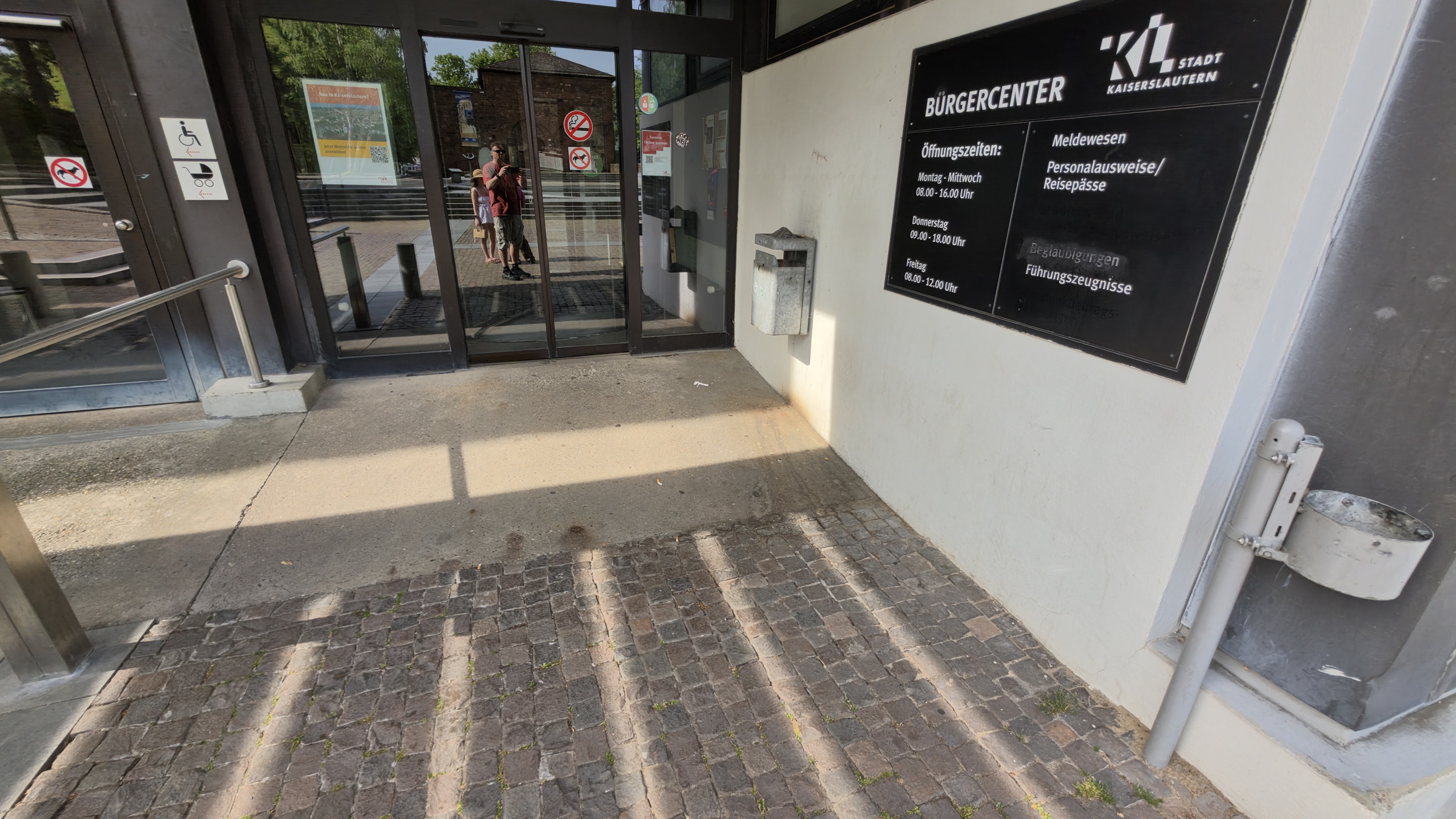
Bürgercenter quick reference (Stadt Kaiserslautern residents)
For residents whose address is inside Stadt Kaiserslautern, the Bürgercenter sits in the Rathaus on Willy-Brandt-Platz.

| Office | Stadt Kaiserslautern Bürgercenter |
| Address | Willy-Brandt-Platz 1, 67657 Kaiserslautern (Rathaus, main floor) |
| Phone | 0631 365-2538 / 0631 365-2772 |
| [email protected] | |
| Mon to Wed | 08:00 to 16:00 |
| Thu | 09:00 to 18:00 |
| Fri | 08:00 to 12:00 |
The city’s own published note says the Bürgercenter is busiest all day Monday and on Thursday from 16:00 onward.[2] An Annahmestopp (cutoff for new arrivals) is possible before the posted closing time if the queue is too long. Practical recommendation: aim for Tuesday or Wednesday morning between 08:00 and 10:00. (Primary source: I went to the Bürgercenter on a weekday morning in July 2023 and waited about 20 minutes. A colleague who tried Monday at 13:00 reported well over two hours.)
VG Ramstein-Miesenbach residents should note the Einwohnermeldeamt there keeps shorter afternoon hours than the Stadt Bürgercenter, with only Thursday running into the evening. Confirm current hours by phone before going.[7]
What happens if you miss the deadline: Ordnungswidrigkeit and fines
As of April 2026: a late or false Anmeldung is an Ordnungswidrigkeit (administrative offense, a civil infraction rather than a criminal act) under BMG §54.[8] Three fine tiers matter:
- Up to €1,000 for the ordinary case of failing to register on time, registering incorrectly, or failing to register at all under BMG §17 Absatz 1.
- Up to €1,000 for a Wohnungsgeber failing to issue or incorrectly issuing the Einzugsbestätigung under BMG §19 Absatz 1.
- Up to €50,000 in the BMG §19 Absatz 6 scenario only: offering or providing an address for a fictitious registration where no actual move-in is happening. This is the anti-Scheinanmeldung (sham-registration) clause, not the late-filer clause.
A first-time Verwarnungsgeld (warning fine, the lower tier before a full Bußgeld) for being a few weeks late tends to be modest in practice. Stadt Kaiserslautern’s service page describes the consequence as mit Verwarnungsgeld bzw. Bußgeld geahndet werden kann. The €50,000 figure is for the rental-scam case (renting out a Briefkasten address without an actual occupant), not for a forgetful arrival who shows up on day 18.
After the appointment: the Meldebescheinigung and what it unlocks
As of April 2026: when the Anmeldung is processed, the clerk hands you an Anmeldebestätigung (the registration confirmation receipt) and on request issues a Meldebescheinigung (the official certificate of registration). BMG §18 governs what goes on the Meldebescheinigung: name(s), Doktorgrad (doctoral title, where held), Geburtsdatum, and current addresses marked as Hauptwohnung or Nebenwohnung. The elektronische Meldebescheinigung is gebührenfrei (free of charge).[9]
What the Meldebescheinigung unlocks next:
- Opening a German bank account (Sparkasse, DKB, ING, Volksbank): every retail bank requires a Meldebescheinigung as part of KYC.
- Filing for the Aufenthaltstitel (residence permit) at the Ausländerbehörde (foreigners’ office): the Anmeldebestätigung is required at intake.
- Registering a vehicle at the Kfz-Zulassungsstelle (vehicle registration office): address proof required.
- Switching from US to German health insurance (TK, AOK, BARMER): the carrier needs proof of residence.
- Enrolling children in a Kita (daycare) or Schule (school): the school confirms the Schulbezirk based on Hauptwohnung.
For Americans arriving on a Familiennachzug visa, the Anmeldung is the first administrative step, and most subsequent steps gate on its receipt. Get it right in the first 14 days and the rest of the chain proceeds in the order the Behörden expect.
When SOFA ends: the BMG clock starts that day (and the 90-day folklore is a different law)
As of May 2026: the most common piece of retiree-folklore at the KMC Stammtisch is “you have 90 days after SOFA expires before you have to deal with German registration.” A related version: “I’ll just become a tourist for 90 days and leave before the clock runs out, so no Anmeldung needed.” Both sentences fail on the same point of law, and the answer is uncomfortable.
Two separate laws are in play. Immigration law (Aufenthaltsgesetz, the Residence Act, riding on Schengen) does give US passport holders a 90-day visa-free window to be physically present in Germany. Registration law (Bundesmeldegesetz) does not. The 14-day BMG §17 clock attaches the day SOFA ends, because the ZA-NTS Art. 6 Abs. 1 exemption (the only thing blocking your Meldepflicht while SOFA held) ends at the same moment SOFA does.[10]
The “I’ll become a tourist and leave in 90 days” version additionally fails on BMGVwV Section 17.1.1, the binding administrative reading of Beziehen einer Wohnung (the BMG §17 trigger). That section says the trigger fires at the beginning of the actual use of the Wohnung. The Besucher exemption that might otherwise apply requires (a) a personal relationship with the dwelling-owner, (b) a temporary stay, AND (c) no payment. A SOFA retiree who has been residentially occupying their German Mietwohnung for years bezogen the Wohnung long ago, that trigger fired the day they first moved in, and the Besucher exemption never applied (you have been paying rent on a long-term Mietvertrag, not visiting a friend).
The pre-existing Beziehen state was masked by SOFA. When SOFA ends, the mask comes off and the Meldepflicht (registration obligation) is immediately on the table. You cannot retroactively un-Beziehen by deciding to leave inside 90 days.[11]
So the practical answer on SOFA-loss day: you are simultaneously a Schengen visitor under Aufenthaltsgesetz (with 90 days to sort an Aufenthaltserlaubnis (temporary residence permit) at the Ausländerbehörde) and meldepflichtig under BMG §17 (with 14 days to register at the Meldebehörde). Two clocks, two offices, two laws. The BMG clock is the shorter and quieter of the two, and the one most retirees miss until they need a Meldebescheinigung to open a German bank account or to file at the Ausländerbehörde itself. And the “I’ll leave within 90 days” plan often fails on Day 91 anyway, because lease termination, vehicle de-registration, household-goods shipping, and Abmeldung (de-registration when leaving Germany) all take longer than 90 days to execute cleanly.
BMG §27 has a temporary-stay exemption for residents of less than six months, but it does not fit a retiree who has been living here for years and intends to stay. The Allgemeine Verwaltungsvorschrift zum Bundesmeldegesetz, the binding interpretation document the Meldebehörden actually work from, is silent on any post-SOFA transition grace.[11] The conservative reading is the one to plan against: register inside 14 days.
Voluntary Anmeldung while still on SOFA: an option with a driver’s license trap
If you can see your retirement date coming, one path is to do a voluntary Anmeldung while you still hold SOFA, so retirement day is a registration non-event. There are real practical reasons to do this besides smoothing the SOFA-loss transition: putting a child on the Schulbezirk rolls for German school enrollment, opening a German bank account under your own Meldebescheinigung, formalizing a joint Hauptwohnung with a German spouse. The Bürgercenter will accept a voluntary Anmeldung from a SOFA member without comment.
The trap is the driver’s license clock. FeV (Fahrerlaubnis-Verordnung, the German driver’s license regulation) §29 makes a foreign driver’s license valid in Germany for six months after the holder establishes an ordentlicher Wohnsitz, and FeV §7 defines ordentlicher Wohnsitz as a substantive center-of-life test (185+ days/year plus persönliche und berufliche Bindungen), not as the Anmeldung date.[12]
Substantively, the same ZA-NTS Art. 6 Abs. 1 SOFA status that exempts you from BMG §17 should also keep FeV §7 from attaching while SOFA holds, voluntary Anmeldung or not. Practically, some Führerscheinstellen (driver-licensing offices) reach for the Anmeldung date as the easily-ascertainable trigger and start the FeV §29 six-month clock from that day. The strict reading and the practice diverge, and the gap is litigable.
The conservative move, if you are a SOFA member considering voluntary Anmeldung and you intend to keep driving on a US license past month six: get a written ruling from your Führerscheinstelle on whether your Anmeldung date will be treated as the FeV §29 trigger, or convert your license to a German one before you register. The driver-license conversion path under FeV Anlage 11 (the federal list of US states whose licenses convert without a full exam) has its own state-of-issue dependencies and deserves its own post, but the planning order matters: license decisions first, voluntary Anmeldung second.
Pink Card and DEERS (Defense Enrollment Eligibility Reporting System) Retiree ID are different documents from Anmeldung
US military retirees do not have SOFA status, but they may qualify for the TrZollV §17 Bescheinigung (commonly called the “Pink Card”), which governs installation purchase privileges (commissary, exchange, on-base fuel). That is a US Forces customs document, not a German residency document, and it does not exempt anyone from BMG §17. The DEERS-issued DoD Retiree ID is the installation gate card and is again a different document. Anmeldung remains your German civil-registration step regardless of what US-side cards you hold post-retirement.
Common Misconceptions vs. What the Regulations Actually Say
The conversations I have had with newly arrived Americans, KMC neighbors, and even US-side admin staff repeat the same mistaken framings about Anmeldung. Each one below is something I have personally heard, paired with what BMG and the registration offices actually say.
-
“I have 90 days to register because I’m an American on a tourist passport (or because my SOFA just expired).”Two laws, two clocks. The Schengen 90/180 visa-free window is an immigration concept under Aufenthaltsgesetz. It governs your right to be physically present in Germany without a residence permit, and yes, you have 90 days to sort an Aufenthaltserlaubnis at the Ausländerbehörde. BMG §17 is a registration rule, and it sets the deadline at two weeks (
zwei Wochen) after move-in for everyone whobezieht eine Wohnungand is not exempt by status (the ZA-NTS Art. 6 Abs. 1 carve-out). Day 15 in your German Mietwohnung without an Anmeldung is already a BMG §54 Ordnungswidrigkeit, and the Schengen window does not extend it. This trap catches retirees on SOFA-loss day more than it catches tourists, because tourists in hotels do notbeziehen einer Wohnungin the first place. -
“I don’t need to register because I’m in on-base housing at Ramstein or Vogelweh, but the day I move off base, the clock starts.”Half right, wrong reason. The exemption is status-based, not housing-based. As a SOFA-status member you are exempt from BMG §17 under ZA-NTS Art. 6 Abs. 1 (implemented in BMG §26) regardless of where you live in Germany. A SOFA-status airman moving from Vogelweh into an Otterbach Mietwohnung remains exempt. What does trigger the 14-day clock is loss of SOFA (retirement, separation, TESA withdrawal), which can happen while you are still living in the same off-base apartment you have rented for years. The off-base move is irrelevant; the status change is what matters.[10]
-
“Everyone in the KMC registers at the Kaiserslautern Bürgercenter.”Only residents inside Stadt Kaiserslautern city limits register at the Bürgercenter. Residents of Landkreis villages register at their Verbandsgemeinde Einwohnermeldeamt instead. For most Americans near Ramstein Air Base that is the VG Ramstein-Miesenbach Einwohnermeldeamt at Am Neuen Markt 6, not the Stadt KL Bürgercenter at Willy-Brandt-Platz 1.
-
“My German spouse is already registered at this address, so I’m covered.”Each meldepflichtige person registers individually. The BMG §22 joint-Hauptwohnung rule lets one household member appear at the registration office with the full packet on behalf of the family, but it does not waive the registration itself. Your name is added to the Wohnung when you move in; the 14-day clock starts on your physical move-in day, not on your spouse’s prior registration date.
-
“I can register with just my passport and a copy of the lease.”Since 1 November 2015, BMG §19 Absatz 3 requires a Wohnungsgeberbestätigung (landlord confirmation), signed by the Wohnungsgeber, with name, owner, address, move-in date, and all registrants. A Mietvertrag is not a substitute. Without the Wohnungsgeberbestätigung, neither the Stadt KL Bürgercenter nor a Verbandsgemeinde Einwohnermeldeamt can complete the Anmeldung.
-
“I’m staying with my in-laws, so the Wohnungsgeberbestätigung doesn’t apply.”It applies. Your German in-laws act as Wohnungsgeber and must sign the same Wohnungsgeberbestätigung that a commercial landlord would sign. BMG §19 Absatz 3 does not exempt relative-provided housing.
-
“The 14-day clock starts when I sign the Mietvertrag.”It starts on physical move-in (
beziehen). Signing the Mietvertrag, taking key delivery while still living elsewhere, and hotel stays during the house-hunt do not start the clock. The trigger is the day you actually begin residential occupation of the Wohnung, per BMG §17 Absatz 1. -
“I can use a Personalausweis with eID to do the Anmeldung online from the US.”Americans on a Familiennachzug residence permit do not get a German Personalausweis (that is for German citizens). The eID-Karte alternative is reserved for EU citizens. A US passport has no eID chip. The Kaiserslautern Elektronische Wohnsitzanmeldung (eWA) launched September 2024 is therefore not available for an American’s first registration; you appear at the Bürgercenter or your Verbandsgemeinde Einwohnermeldeamt in person.
-
“Photocopies of birth and marriage certificates are fine for Anmeldung.”The registration office requires Geburtsurkunden and the Heiratsurkunde im Original oder als beglaubigte Abschrift (certified copy). Plain photocopies are rejected. If your US marriage certificate is in active use elsewhere, get an apostilled certified copy plus a beglaubigte Übersetzung before the appointment.
-
“If I’m late, I’ll be hit with the €50,000 fine I read about online.”Wrong tier. BMG §54 Absatz 3 caps the late-filer fine at up to €1,000, and a first-time Verwarnungsgeld for a few weeks late is typically modest in practice. The €50,000 figure (also in BMG §54 Absatz 3) is reserved for §19 Absatz 6 violations: the Scheinanmeldung scenario where someone offers a Briefkasten address for a fictitious registration with no actual move-in. Forgetting and showing up on day 18 is not that case.
-
“Doing the Anmeldung makes me a German tax resident.”Anmeldung is a residence-registration administrative act under BMG; it is not by itself the trigger for unbeschränkte Steuerpflicht (unlimited German income tax liability) under EStG (Einkommensteuergesetz, the German income tax act) §1. German tax residency is a center-of-life-interests test (Wohnsitz or gewöhnlicher Aufenthalt). The Anmeldung is evidence in that test, not the test itself. The Steuer-ID (tax identification number, issued automatically by the Bundeszentralamt für Steuern, the federal central tax office) arrives in the mail automatically after Anmeldung as a registration-system byproduct, not as an opt-in to taxation.
-
“When SOFA ends I’ll just become a tourist for 90 days, leave Germany before day 91, and skip the Anmeldung entirely.”The Meldepflicht trigger (
Beziehen einer Wohnung, BMG §17 Abs. 1 + BMGVwV 17.1.1) ALREADY fired the day you first moved into your German apartment, often years ago. BMGVwV 17.1.1 says the trigger is the beginning of actual use of the Wohnung. The Besucher exemption that might otherwise apply requires no payment and a personal-relationship visit, neither of which describes a long-term Mietvertrag. The ZA-NTS Art. 6 Abs. 1 SOFA exemption was the ONLY thing blocking your Meldepflicht while it held. When SOFA ends, the pre-existing Beziehen state becomes meldepflichtig immediately. You cannot retroactively un-Beziehen by planning to leave inside 90 days. The 90-day Schengen window covers your right to be physically present (Aufenthaltsgesetz), not your registration obligation. And the “I’ll leave within 90 days” plan often fails on Day 91 because lease termination, vehicle de-registration, household-goods shipping, and Abmeldung all take longer than that to execute cleanly.[11] -
“I’ll fly to Germany on the 90-day Schengen window and find a SOFA job, so I can stay tax-exempt.”The plan fails before it starts. SOFA-eligible jobs are filled through US-side hiring: active-duty military arrives on PCS orders, DoD civilians come over with their SOFA certificate already issued, TESA-accredited contractors are sponsored from the US side with security clearance and a contract in hand. None of those paths run through a Schengen tourist showing up at Ramstein with a resume. AEA Reg 715-9 specifically excludes TESA accreditation for applicants who are “ordinarily resident” in Germany at the time of application, so renting an apartment in Germany while you job-shop self-disqualifies you. Entering Germany on the 90/180 visa-free window with the intent to find work and stay is also a misuse of Schengen visa-free entry that can trigger Aufenthaltsgesetz §95 problems.[13]
-
“I’ll fly to Germany on the 90-day Schengen window, rent an apartment, find a job, and migrate.”The plan fails on residence-permit law. The Aufenthaltstitel zur Erwerbstätigkeit (work residence permit) generally must be applied for from your home country at the German consulate before entry, via the visa process. Aufenthaltsverordnung (Residence Regulation) §39 narrowly limits in-Germany change-of-purpose to specific categories that do not include “I got here as a tourist and now want to work.” The Chancenkarte job-seeker visa (Aufenthaltsgesetz §20) also requires a home-country application. The Schengen 90/180 window is for tourism and visiting, not job-search or employment, and taking up work on it is unlawful. Day 91 you are in Aufenthaltsgesetz §95 illegal-stay territory whether you filed an Anmeldung or not, and the Ausländerbehörde does talk to the Meldebehörde. The realistic legal path to migrate is: pick the right Aufenthaltstitel category (work, study, Familiennachzug, Chancenkarte), apply at the German consulate in the US, enter Germany on the issued visa, then do Anmeldung inside 14 days.
Sources
- Bundesmeldegesetz §17, gesetze-im-internet.de/bmg/__17.html (retrieved 2026-05-14).
- Stadt Kaiserslautern Bürgerservice, Anmeldung einer Wohnung, kaiserslautern.de/serviceportal/dl/020680/index.html.de (retrieved 2026-05-14).
- Bundesmeldegesetz §19, gesetze-im-internet.de/bmg/__19.html (retrieved 2026-05-14).
- Stadt Kaiserslautern Wohnungsgeberbestätigung Vordruck, kaiserslautern.de/serviceportal/form/040825/index.html.de (retrieved 2026-05-14).
- Stadt Kaiserslautern Anmeldung Vordruck, kaiserslautern.de/serviceportal/form/032181/index.html.de (retrieved 2026-05-14).
- Stadt Kaiserslautern Pressemitteilung 2024-09-02, Elektronische Wohnsitzanmeldung, kaiserslautern.de/buerger_rathaus_politik/medienportal/pressemitteilungen/074490/index.html.de (retrieved 2026-05-14).
- Verbandsgemeinde Ramstein-Miesenbach, Infos und Formulare Einwohnermeldeamt, ramstein-miesenbach.de/de/verwaltung/infos-und-formulare-einwohnermeldeamt/ (retrieved 2026-05-14).
- Bundesmeldegesetz §54, gesetze-im-internet.de/bmg/__54.html (retrieved 2026-05-14).
- Bundesmeldegesetz §18, gesetze-im-internet.de/bmg/__18.html (retrieved 2026-05-14).
- Zusatzabkommen zum NATO-Truppenstatut (ZA-NTS), 3. August 1959, BGBl. 1961 II S. 1183, 1218, Art. 6 Abs. 1 (Befreiung von melderechtlichen Vorschriften); implementing source Bundesmeldegesetz §26 Satz 1 Nr. 2, gesetze-im-internet.de/bmg/__26.html (retrieved 2026-05-19). BMGVwV 17.1.1 (definition of Beziehen einer Wohnung and the Besucher-exemption requirements) at verwaltungsvorschriften-im-internet.de.
- Allgemeine Verwaltungsvorschrift zur Durchführung des Bundesmeldegesetzes (BMGVwV), Neufassung vom 27. September 2022, Abschnitt 26 (Befreiung von der Meldepflicht). Source: verwaltungsvorschriften-im-internet.de, bsvwvbund_27092022_VII2201041418.htm (retrieved 2026-05-19).
- Fahrerlaubnis-Verordnung §7 (Ordentlicher Wohnsitz im Inland) and §29 (Ausländische Fahrerlaubnisse). Sources: gesetze-im-internet.de/fev_2010/__7.html and gesetze-im-internet.de/fev_2010/__29.html (retrieved 2026-05-19).
- Army in Europe Regulation 715-9 (NATO SOFA Status Accreditation for DoD Contractor Employees in Germany), 6. April 2022, Headquarters US Army Europe and Africa. Source: media.defense.gov, media.defense.gov/2022/Apr/06/2002970812/-1/-1/0/AER715-9.PDF (retrieved 2026-05-19).